*SIFF FutureWave Selection*
It's very easy to call this movie good. Even if you don't entirely understand it, the emotions it propagates are undeniably moving. It's the images of the collapsed soldier, a bloodied Eli lying facedown in the desert, and Mina screaming as her life is ripped apart that ensure the film stays with you long after its credits roll. But I will argue that for the deeper and more universal conclusions that can be drawn from *Fig Tree*, it is much more than a good movie. Instead, it is a masterpiece of messages.
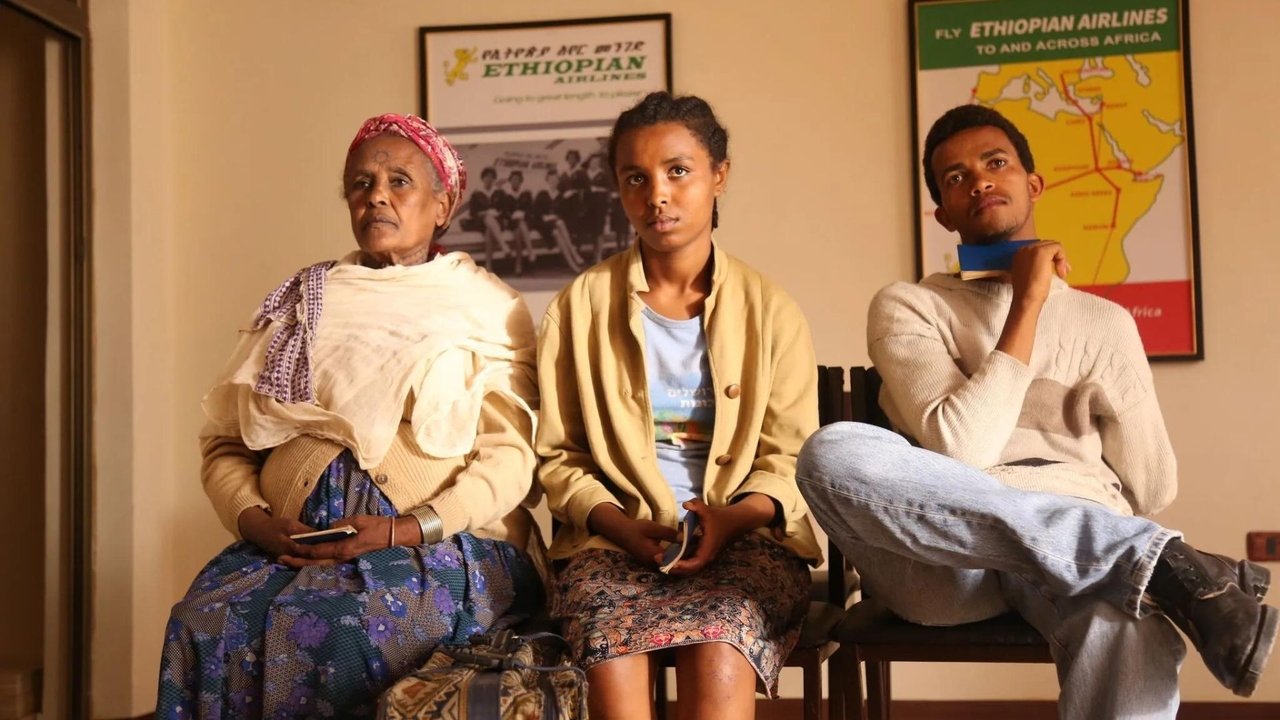
It's easy to tell that director Alamork Davidian works hard to add depth to his narrative in the form of metaphors and hidden messages. When the rescued veteran tells the story of his kidnapping to Mina and her grandmother, it seems obvious that his broken sentences and irregular narrative carry deeper meaning. Likewise, when he collapses in the street just minutes later while running away from Mina's home, the appearance of a housewife carrying a broom and sweeping a cloud of dust that covers him in the frame cannot be a coincidence. We feel the same thing when Eli's mother talks about "getting over" hell, or when Mina and her grandmother eerily take a sip of water at the exact same time while watching dictator Mengistu Haile Mariam deliver an impassioned speech about the need for a united front in the civil war. These moments are all very subtle, but considering them we realize that they must have all been deliberate decisions on the part of Davidian. What's harder, then, is to determine what each of these quiet images means. Even more difficult is to figure out how they combine with the rest of the film to provide a universal lesson.
I cannot claim to fully understand what this lesson is. I can only really provide conjectures. I will flesh out my conjecture as much as possible so as to prove that it is not simply the wild guess of an idealist. However, it may exist alongside or contrary to a host of other possible themes for this film, each with its own merits and shortcomings.
I believe that this film is a 93-minute attempt at communicating the idea that in a world of despotism, individuals' lack of control over their own lives renders those lives meaningless. Their actions cannot achieve any change in their situations and they are ultimately driven to an intense selfishness as they desperately and vainly follow every possible avenue of escape.
This idea begins for me with the suicidal veteran. Understanding the hopelessness of his life and the futility of any action to fight against the higher powers that control it, he attempts to end it. The naïve Mina and Eli, not fully aware of their desperate environment, foil his efforts. When he wakes at Mina's house, he quietly mourns the pointless care they put into his well-being. As he cryptically explains to them, the last time he was optimistic enough to take such care of himself was when he visited the tailor to have a new set of clothes made. He was kidnapped before they could be finished and the pants were just "left there." They would never serve their purpose, as he would go on to lose his legs in a war that he was forced to fight. Thus, any similar attempts at restoring his humanity were, he believed, wasteful. When he escapes and subsequently collapses in the street, it's the woman "sweeping him away" that illustrates the society's apathy towards death. The end of life is an inevitability and cannot be mourned as a tragedy.
Eli's mother believes in the same circumstances as the veteran. She, too, understands that the world they live in is hell. She acknowledges the futility of ambition in a hopeless world, but instead regards the situation with a twisted, almost Camusian, optimism that suggests everyone must take pleasure in their presence nonetheless. One must "get over" hell and live for the sake of living, not for any nobler purpose.
Mina and Eli do not understand this. They are young, and cannot believe that the seemingly eternal years that lie before them are inherently meaningless. As Eli remarks, their fig tree represents heaven, as it is a place where people can be saved from the hellish world around them. It's where they can escape the despotic environment that surrounds them and where the veteran's life can be restored. Naïvely, they cannot see that their secluded paradise simply drags out their suffering.
When Mina's family finally has the opportunity to leave the country, she feels obligated to ensure Eli comes with. She's cannot understand that in her country's current circumstances, one must be selfish enough to seize any chance at escape. Mina's grandmother and brother grasp this idea. They do not make any significant effort to care for anyone outside of their family, knowing that it may compromise their own survival. When they learn of Mina's secret ploys to save Eli, they beat her for it. To the unaware, it seems harsh, almost abusive. But they justify it with the belief that their escape alone is of chief importance. It's the same self-concern that Mina's mother showed when she was given the opportunity to flee to Israel. Now safe and removed from her hellish existence of Ethiopia, she can begin to worry about her own mother and children. Mina's grandmother understands this and is able to forgive her for it. Mina cannot understand and resent her mother for her selfishness, refusing to even talk to her on the phone.
In the final scene of the movie, the dictum of self-concern that the mature in Ethiopia live by is justified. Despite Mina's selfless actions, Eli is ripped from his family by the authorities and one can only guess that Mina's family becomes endangered for their complicity in the boy's hiding. Hell has found another victim. Only the disillusioned live on unaffected.
It's nearly certain that I am reading too much into this movie. I doubt that Davidian believed in the theory that I have proposed to the same extent that I do. However, that I am inspired to believe in it should speak to the film's merits. In *Fig Tree*, I found a movie that made me think. At the same time, it dazzled me with its stunning cinematography and engaged me with its understated score that beat in sync with Mina's heart. I cannot stress the tremendous experience I had while watching this movie and I can't wait to see it again.