

Gladiator
Democracy vs dictatorship
Aside from all the obvious points that this movie is visually stunning, that the music is masterful, and that it has some fantastic action scenes, I want to talk for a bit about the underlying story that makes it such a good movie. Please keep in mind that I have watched the extended edition.
Spoilers ahead btw!!!
Lets start off by looking at the main character: Maximus. Right from the beginning, he is portrayed as a man of the people: his soldiers trust him with their lives and follow him time and again into battle. This makes him a successful commander, leading the romans to victory in their wars against the Germanic tribes. This makes him popular not only under the soldiers, but also with politicians and women. Yet despite all his success, he longs for nothing more than a peaceful life with his wife and son. Caring not for his own reputation and fame but solely for the wellbeing of his loved ones and the people of Rome is a recurring theme for Maximus' character. Marcus Aurelius sees this and wants Maximus to succeed him, knowing that he will do the right thing to bring the emperor his power back to the senate, making Rome a true democracy again.
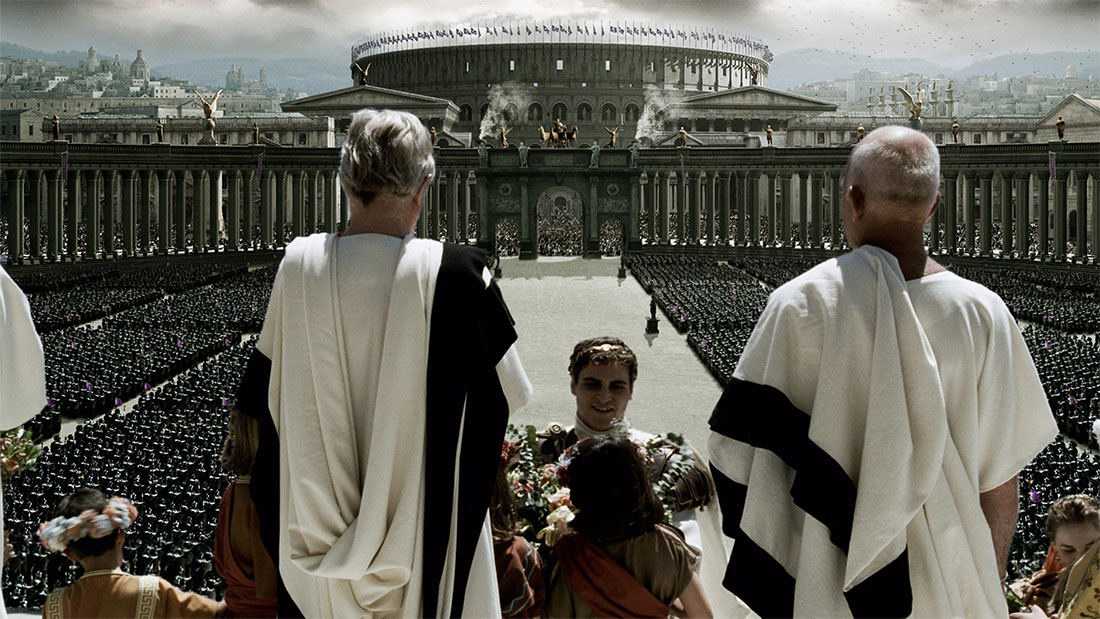
The antegonist in the movie is Commodus, the son of Marcus Aurelius. He does not occupy himself with the welfare of the Roman people, but only wants (quite desperately) to be liked by other people. Tragically, noone does, not even his own father. This is the reason for his desire to be the emperor: he wants to make his father proud and be liked by the people. It is not difficult to see how he is jealous of Maximus, since his impeccable reputation is all that Commodus has ever desired. Throughout the story, Commodus his character represents dictatorship and is the main threat to Maximus, who represents the voice of the people, or democracy.
Commodus claims the throne by killing his own father, and orders the killing of Maximus and his family. Maximus only manages to get away himself, and ends up being enslaved as a gladiator. Upon his return to Rome, Commodus gets bood by the people and even gets judged by the senators for behaving like a conqueror while he has never actually achieved something or done something for the benefit of Rome and its people. It does not take long for Commodus to make some incredibly selfish decisions, causing his sister and two senators to conspire against him. The involvement of the senate here makes that the philosophical dilemma 'dictatorship vs democracy' is implemented rather explicitly into the story.
At around the same point in the story, after Maximus gets his identity taken away from him, he has his first fights as a gladiator. He does what needs to be done to survive: kill his enemies in the arena, leading to the iconic "Are you not entertained?" scene. As Maximus learns from his slave master (exclusive to extended edition I believe), the public wants to see a more spectacular show. He teaches Maximus that getting liked by the public might be the way to get his freedom back. Maximus changes his ways and proves that he is (even as a slave!) able to win the hearts of the people yet again, which becomes visible as he arrives in Rome. All this development is essential for his character, as it shows that Maximus has had to work very hard to make himself a symbol of hope for the people. This stands in stark contrast to Commodus, who has only tried to get the people to like him by organizing games, for which he paid by selling the peoples grain reserves. Yet still Commodus wonders why he is disliked.
This inability to please the public no matter what he does, logically leads to frustration and anger with Commodus. The obvious reason for this is that Maximus his popularity is a threat to his power: he can't simply kill him or get rid of him in another quick and easy way, because that would make him a martyr. There is something else in play however: because of Phoenix his brilliant acting, we see that it also pains Commodus a lot to see that he is so disliked. Perhaps he believes (maybe even only subconciously) that this must be because of a fault of his own. I think that this is an error in his reasoning: even if Commodus would have been a good emperor for the people, it would have made sense if the people of Rome sympasized more not with an emperor who was born into power, but rather with a gladiator that came from nothing just like themselves.
Another interesting scene that displays the dynamic between Commodus and Maximus, is the following: at some point, Maximus has defeated his opposing gladiator in a duel. The spectators shout unanimously that Maximus should kill him. Commodus thinks to grant their wish by giving Maximus the order to kill. But when Maximus refuses to do so, the public does not boo him, but actually praises him for being merciful. This again proves that the people do not want to follow a power-hungry dictator that is desperate for them to like him, but that they rather prefer a figure that they chose to like themselves who displays strong character, even if that includes something they did not want initially.
Fast forward to the ending, which I found very satisfying. Maximus and his supporters fail their plan to reinstate the republic, because Commodus forsaw it. Not wanting to make him a martyr, he challenges Maximus to a duel in the colosseum. Before entering however, he stabs Maximus in his back, giving him a major disadvantage. Still, he is able to disarm Commodus. Upon ordering a guard to give him his sword, the guard refuses, and orders all other guards to do the same: the people their aversion of Commodus turns out to be the cause of his death. After killing the emperor, Maximus still dies to his stab wound. This can still be seen as a happy ending for him however since both his wishes are fulfilled: he has ended the rule of the emperor which brings Rome one step closer to being a democracy again, and he finally gets to be reunited with his family in the afterlife.
As is hopefully clear by now, the constantly recurring theme in this movie is the battle between what the emperor wants and what the people want. The movie contains tons and tons of amazing and iconic quotes relating to this theme that I can't possibly list all in this review, but two that I liked a lot are:
"I knew a man once. A noble man who loved my father, and my father loved him. This man served Rome well."
"That man is gone, your brother did his work well"
And:
"You have a great name. He must kill your name before he kills you"
Both these quotes still work really well when you use Maximus his persona as a metaphor for democracy.
Before finishing my review, I want to give a huge compliment to Joaquin Phoenix. His performance was just simply incredible. I was astounded by how much depth and nuance he was able to provide to Commodus' character. We live in a time where it is unfortunately very common to have a story characterized by "protagonist good, antagonist bad", with anger as the most visible emotion of the antegonist. This is I think especially true when considering movies and shows kings/emperors as antagonist. Phoenix however does something something unique with Commodus: rarely have I seen an actor play such an angry character while at the same time displaying so much vulnerability, often even both at the same time! We get to see a lot of the underlying sadness, pain and jealousy that drive Commodus to be so angry. I truly believe that his acting is what makes this a great movie instead of a very good movie.