
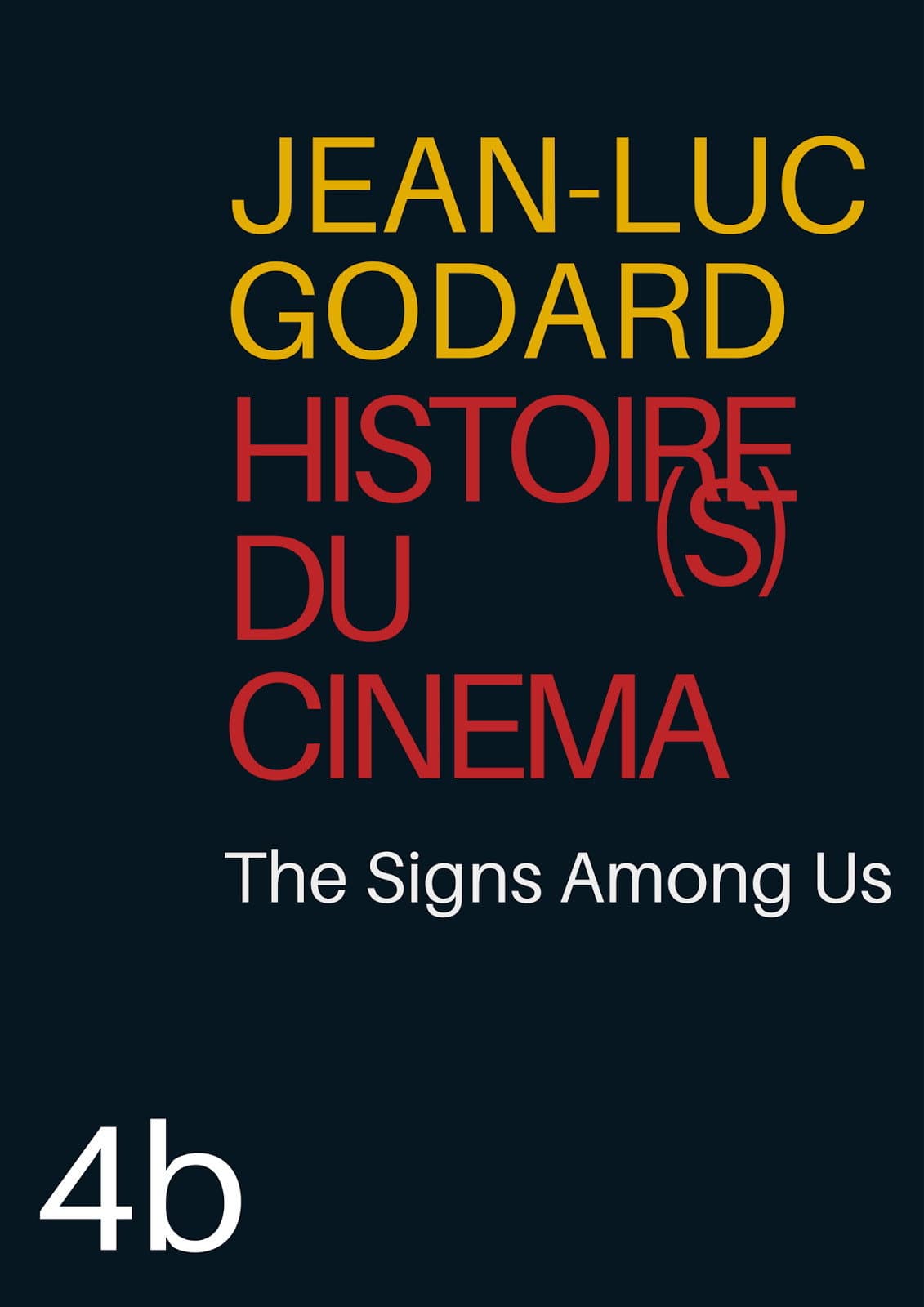
Histoire(s) du Cinéma 4b: The Signs Among Us
2006·Documentary·37m
7.1
★
Part 8 of Godard's 8 part examination of the history of the concept of cinema and how it relates to the 20th century.
Directed by Jean-Luc Godard

IMDB
N/A
Cast

Jean-Luc Godard
Self (uncredited)
Crew
Jean-Luc Godard
Director
Jean-Luc Godard
Writer
Jean-Luc Godard
Editor
Popular Reviews
5 reviews
Gabriel Silva
8.6★ · 09/06/23
Sight and Sound’s Greatest Films of All Time watch challenge #183 - (film =78 out of 264)
Essentially a video essay, Jean-Luc Godard’s Historie(s) du Cinéma is divided into eight parts examining the role of film throughout history and how it relates to the twentieth century as a whole. I, already not being a huge fan of Godard’s work based off of what I’ve seen so far this year, was not looking forward to diving into what I felt would be a dry, boring, and bloated bloviation. A single line in the first part, 1a: All the (Hi)stories, made me feel a bit more optimistic despite finding the editing style annoying and distracting initially. “If George Stevens hadn’t used the first 16mm colour film in Dachau, Elizabeth Taylor would have never found a place in the sun”. That stuck with me and made me look forward to watching the next part, 1b: A Single (Hi)story. I was disappointed, found myself annoyed at the repetitiveness of Godard’s meditations on film. A friend did say to me that going from early new wave Godard (as I had) to essayist Godard was like “jumping head first into concrete” and boy did I have that feeling.
However, after wading in the splatter of my own skull across the pavement as I continued to play part after part, Godard’s ruminations started to make more sense to me. This was an examination on film that was as deep a conversation as I wish I could’ve had several years ago. The flashing, juxtaposed imagery of films I had seen before on screen accompanying the narration of a history of film, the role it plays, its nature as art, and the soul of creativity itself became, at times, exhibit unto its own, a guided tour of film and cinematography that saw more potential in art than businessmen ever could. This was not an easy watch. I don’t expect myself to be rewatching this anytime soon. I’ll probably give it another go several years down the line, but right now this film exists as a sad reflection on an art form that is misunderstood and disrespected due to its sheer abundance in our culture to the point that we have since reduced the existence of it to “content” in the age of streaming media.
Essentially a video essay, Jean-Luc Godard’s Historie(s) du Cinéma is divided into eight parts examining the role of film throughout history and how it relates to the twentieth century as a whole. I, already not being a huge fan of Godard’s work based off of what I’ve seen so far this year, was not looking forward to diving into what I felt would be a dry, boring, and bloated bloviation. A single line in the first part, 1a: All the (Hi)stories, made me feel a bit more optimistic despite finding the editing style annoying and distracting initially. “If George Stevens hadn’t used the first 16mm colour film in Dachau, Elizabeth Taylor would have never found a place in the sun”. That stuck with me and made me look forward to watching the next part, 1b: A Single (Hi)story. I was disappointed, found myself annoyed at the repetitiveness of Godard’s meditations on film. A friend did say to me that going from early new wave Godard (as I had) to essayist Godard was like “jumping head first into concrete” and boy did I have that feeling.
However, after wading in the splatter of my own skull across the pavement as I continued to play part after part, Godard’s ruminations started to make more sense to me. This was an examination on film that was as deep a conversation as I wish I could’ve had several years ago. The flashing, juxtaposed imagery of films I had seen before on screen accompanying the narration of a history of film, the role it plays, its nature as art, and the soul of creativity itself became, at times, exhibit unto its own, a guided tour of film and cinematography that saw more potential in art than businessmen ever could. This was not an easy watch. I don’t expect myself to be rewatching this anytime soon. I’ll probably give it another go several years down the line, but right now this film exists as a sad reflection on an art form that is misunderstood and disrespected due to its sheer abundance in our culture to the point that we have since reduced the existence of it to “content” in the age of streaming media.
Sight and Sound’s Greatest Films of All Time watch challenge #183 - (film =78 out of 264)
Essentially a video essay, Jean-Luc Godard’s Historie(s) du Cinéma is divided into eight parts examining the role of film throughout history and how it relates to the twentieth century as a whole. I, already not being a huge fan of Godard’s work based off of what I’ve seen so far this year, was not looking forward to diving into what I felt would be a dry, boring, and bloated bloviation. A single line in the first part, 1a: All the (Hi)stories, made me feel a bit more optimistic despite finding the editing style annoying and distracting initially. “If George Stevens hadn’t used the first 16mm colour film in Dachau, Elizabeth Taylor would have never found a place in the sun”. That stuck with me and made me look forward to watching the next part, 1b: A Single (Hi)story. I was disappointed, found myself annoyed at the repetitiveness of Godard’s meditations on film. A friend did say to me that going from early new wave Godard (as I had) to essayist Godard was like “jumping head first into concrete” and boy did I have that feeling.
However, after wading in the splatter of my own skull across the pavement as I continued to play part after part, Godard’s ruminations started to make more sense to me. This was an examination on film that was as deep a conversation as I wish I could’ve had several years ago. The flashing, juxtaposed imagery of films I had seen before on screen accompanying the narration of a history of film, the role it plays, its nature as art, and the soul of creativity itself became, at times, exhibit unto its own, a guided tour of film and cinematography that saw more potential in art than businessmen ever could. This was not an easy watch. I don’t expect myself to be rewatching this anytime soon. I’ll probably give it another go several years down the line, but right now this film exists as a sad reflection on an art form that is misunderstood and disrespected due to its sheer abundance in our culture to the point that we have since reduced the existence of it to “content” in the age of streaming media.
Essentially a video essay, Jean-Luc Godard’s Historie(s) du Cinéma is divided into eight parts examining the role of film throughout history and how it relates to the twentieth century as a whole. I, already not being a huge fan of Godard’s work based off of what I’ve seen so far this year, was not looking forward to diving into what I felt would be a dry, boring, and bloated bloviation. A single line in the first part, 1a: All the (Hi)stories, made me feel a bit more optimistic despite finding the editing style annoying and distracting initially. “If George Stevens hadn’t used the first 16mm colour film in Dachau, Elizabeth Taylor would have never found a place in the sun”. That stuck with me and made me look forward to watching the next part, 1b: A Single (Hi)story. I was disappointed, found myself annoyed at the repetitiveness of Godard’s meditations on film. A friend did say to me that going from early new wave Godard (as I had) to essayist Godard was like “jumping head first into concrete” and boy did I have that feeling.
However, after wading in the splatter of my own skull across the pavement as I continued to play part after part, Godard’s ruminations started to make more sense to me. This was an examination on film that was as deep a conversation as I wish I could’ve had several years ago. The flashing, juxtaposed imagery of films I had seen before on screen accompanying the narration of a history of film, the role it plays, its nature as art, and the soul of creativity itself became, at times, exhibit unto its own, a guided tour of film and cinematography that saw more potential in art than businessmen ever could. This was not an easy watch. I don’t expect myself to be rewatching this anytime soon. I’ll probably give it another go several years down the line, but right now this film exists as a sad reflection on an art form that is misunderstood and disrespected due to its sheer abundance in our culture to the point that we have since reduced the existence of it to “content” in the age of streaming media.


GoldratusPRO
8.0★ · 11/06/25
Félix Perdriau
10.0★ · 09/18/25
Kris
10.0★ · 04/04/22
Kris
10.0★ · 04/04/22