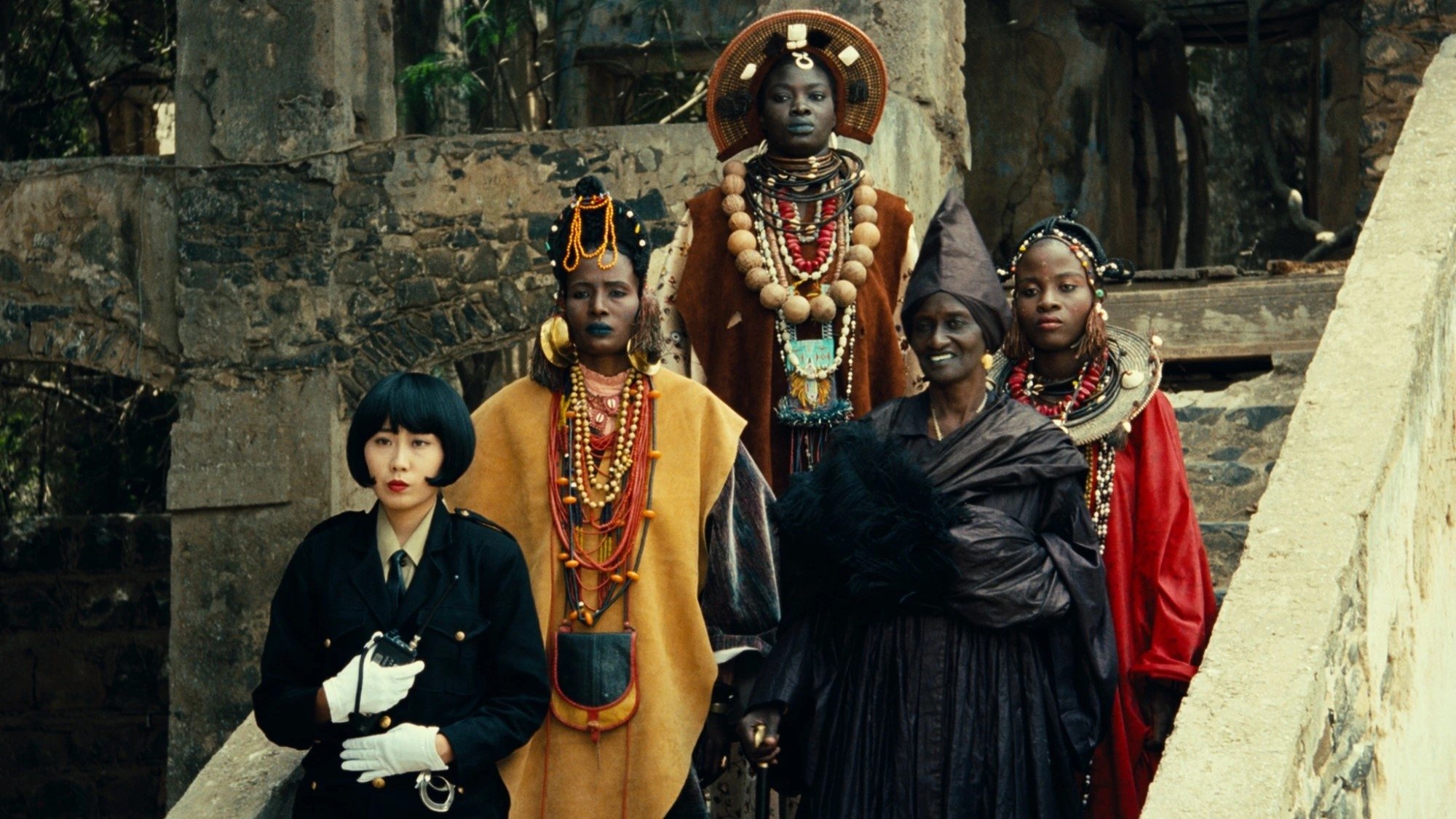
Like many Senegalese films, Hyenas is direct and scathing in its criticism of classism and the remnants of the colonial mindset even decades after Senegalese independence, coinciding with the expansion of global capitalism in the late 80s and early 90s. We see Sony televisions in churches, and the offer of a working man’s killing surrounded by a literal carnival à la Billy Wilder’s Ace in the Hole. For its directness, it is also willing to make the main conflict somewhat morally grey while reserving its sympathies for the townspeople, rather than the bourgeois woman who offers aid to the town in exchange for the life of a decades-old ex-lover, a social critique that’s as concerned with the gender dynamics as it is with class—the latter a subject matter that more mainstream western narratives are far less willing to tackle. Later on we see the more vibrant town community juxtaposed with the new skyscrapers and carnivals, seeing this modernization as a neocolonial invasion rather than a sign of prosperity. The film starts with a deceptively light tone as it establishes the community, like many political films, but becomes increasingly somber and hopeless as the invasion continues, knowing well that the town and main character are doomed. The film looks gorgeous too, with vibrant colors and stunning wides of the desert, helped by a recent restoration. There’s so much to chew on here that I could notice more on a second viewing. My only real qualm is with the soundtrack: at many points the electronic score is powerful and atmospheric, but at other points it sounds strangely goofy and tacky for the film it’s in.
Like many Senegalese films, Hyenas is direct and scathing in its criticism of classism and the remnants of the colonial mindset even decades after Senegalese independence, coinciding with the expansion of global capitalism in the late 80s and early 90s. We see Sony televisions in churches, and the offer of a working man’s killing surrounded by a literal carnival à la Billy Wilder’s Ace in the Hole. For its directness, it is also willing to make the main conflict somewhat morally grey while reserving its sympathies for the townspeople, rather than the bourgeois woman who offers aid to the town in exchange for the life of a decades-old ex-lover, a social critique that’s as concerned with the gender dynamics as it is with class—the latter a subject matter that more mainstream western narratives are far less willing to tackle. Later on we see the more vibrant town community juxtaposed with the new skyscrapers and carnivals, seeing this modernization as a neocolonial invasion rather than a sign of prosperity. The film starts with a deceptively light tone as it establishes the community, like many political films, but becomes increasingly somber and hopeless as the invasion continues, knowing well that the town and main character are doomed. The film looks gorgeous too, with vibrant colors and stunning wides of the desert, helped by a recent restoration. There’s so much to chew on here that I could notice more on a second viewing. My only real qualm is with the soundtrack: at many points the electronic score is powerful and atmospheric, but at other points it sounds strangely goofy and tacky for the film it’s in.