I feel I've been putting off talking about 'The Big Bus' for a bit, not because I've nothing to say, but because I'm having a hard time thinking of anything 'original' to say (which is a bit of a thing on its own, as you may see).
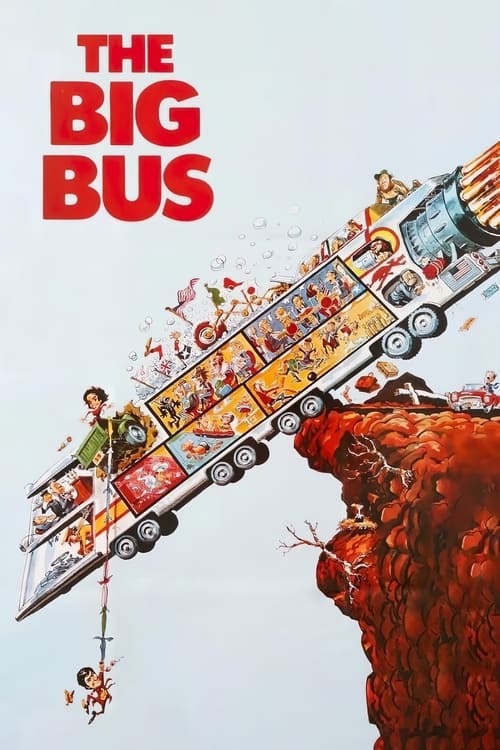
Released in 1976 to a seemingly uninterested world (it does not appear to have set the box-office alight), 'The Big Bus' explicitly sets itself (in both the trailer and the actual film's pre title text) in line with 'The Towering Inferno,' 'Airport' & 'Airport 1975,' 'The Poseidon Adventure,' 'Earthquake,' and 'The Hindenburg,' a veritable firehose of disaster movies hitting cinemas in the 1970s. 'The Big Bus' (or BB) is a parody of those films (and others): like them, it features a location (the bus itself), a cast of passengers played by celebs of varying star power, and replicates scenes (or aspects of scenes) from its forbearers which are skewed to comic effect (or, at least, comic intent).
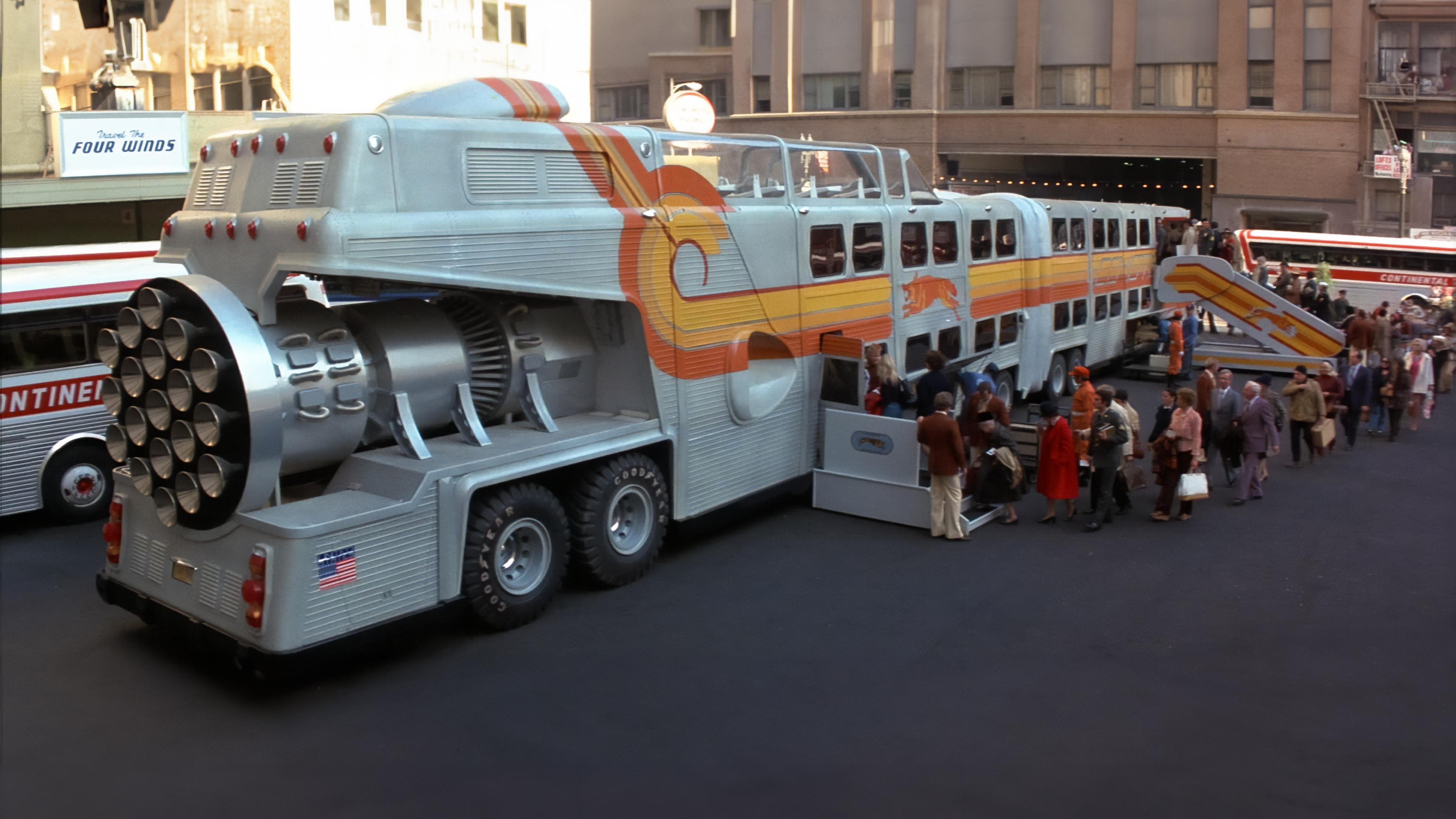
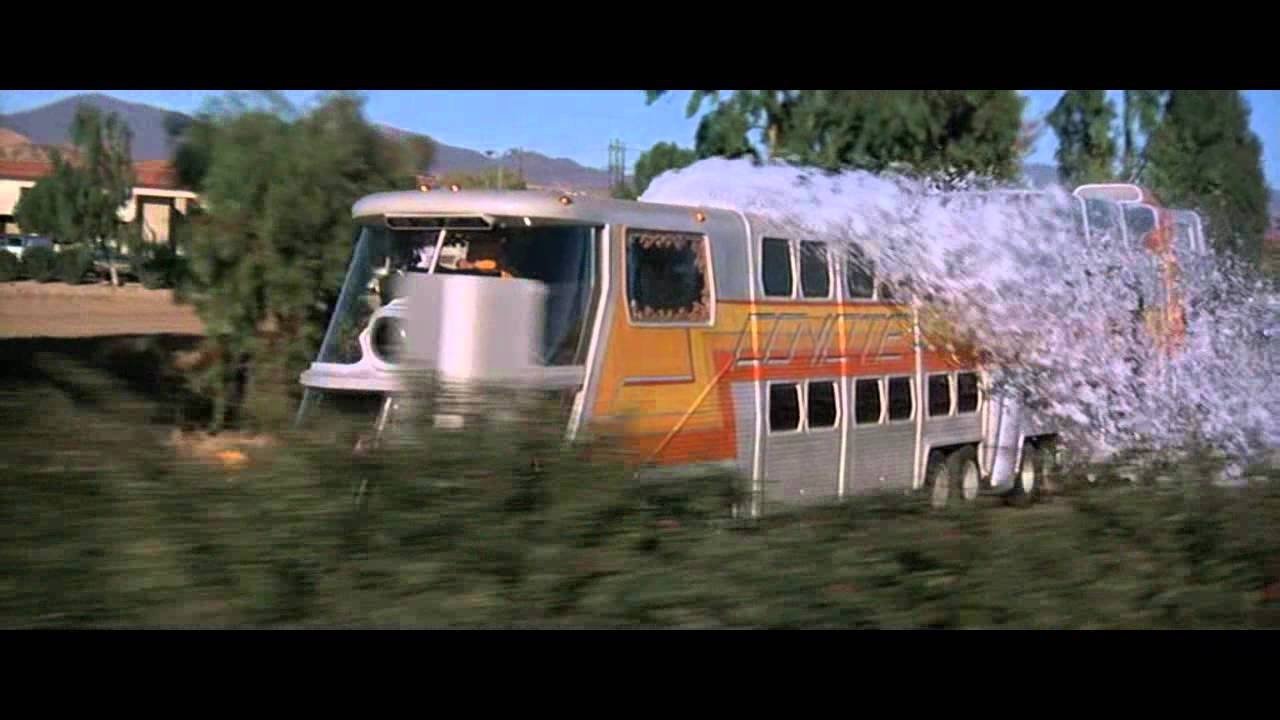
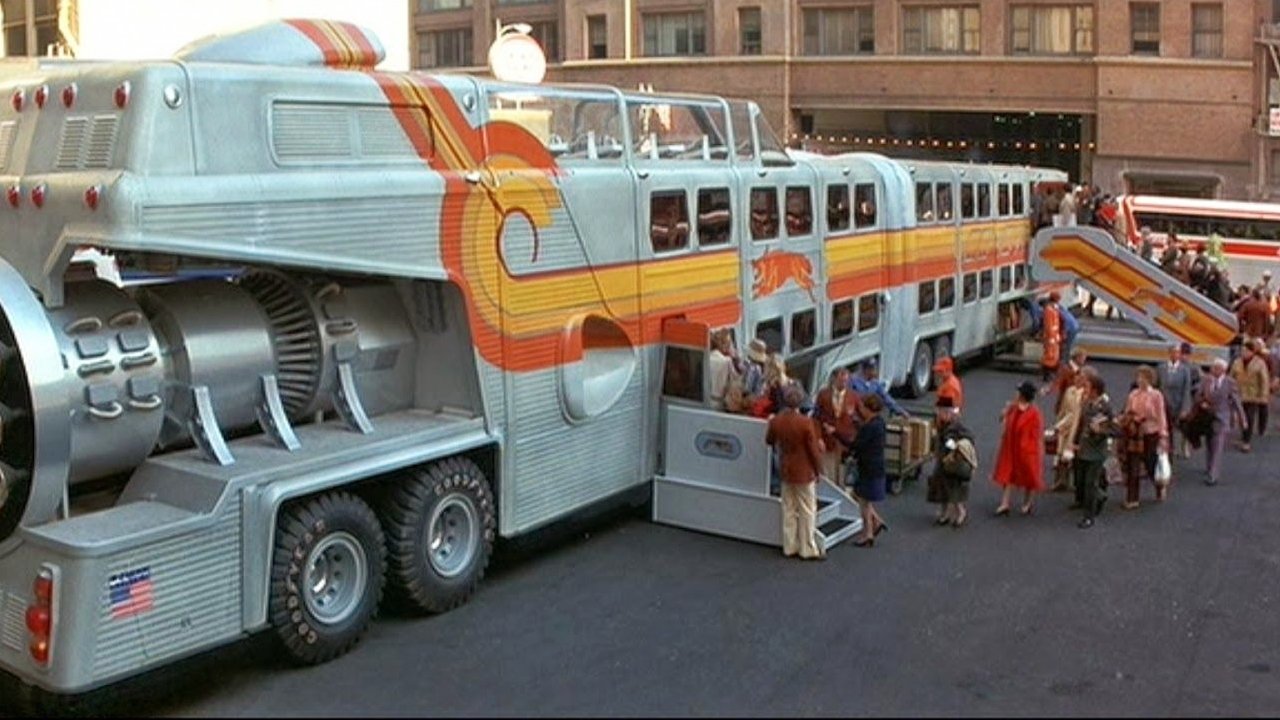
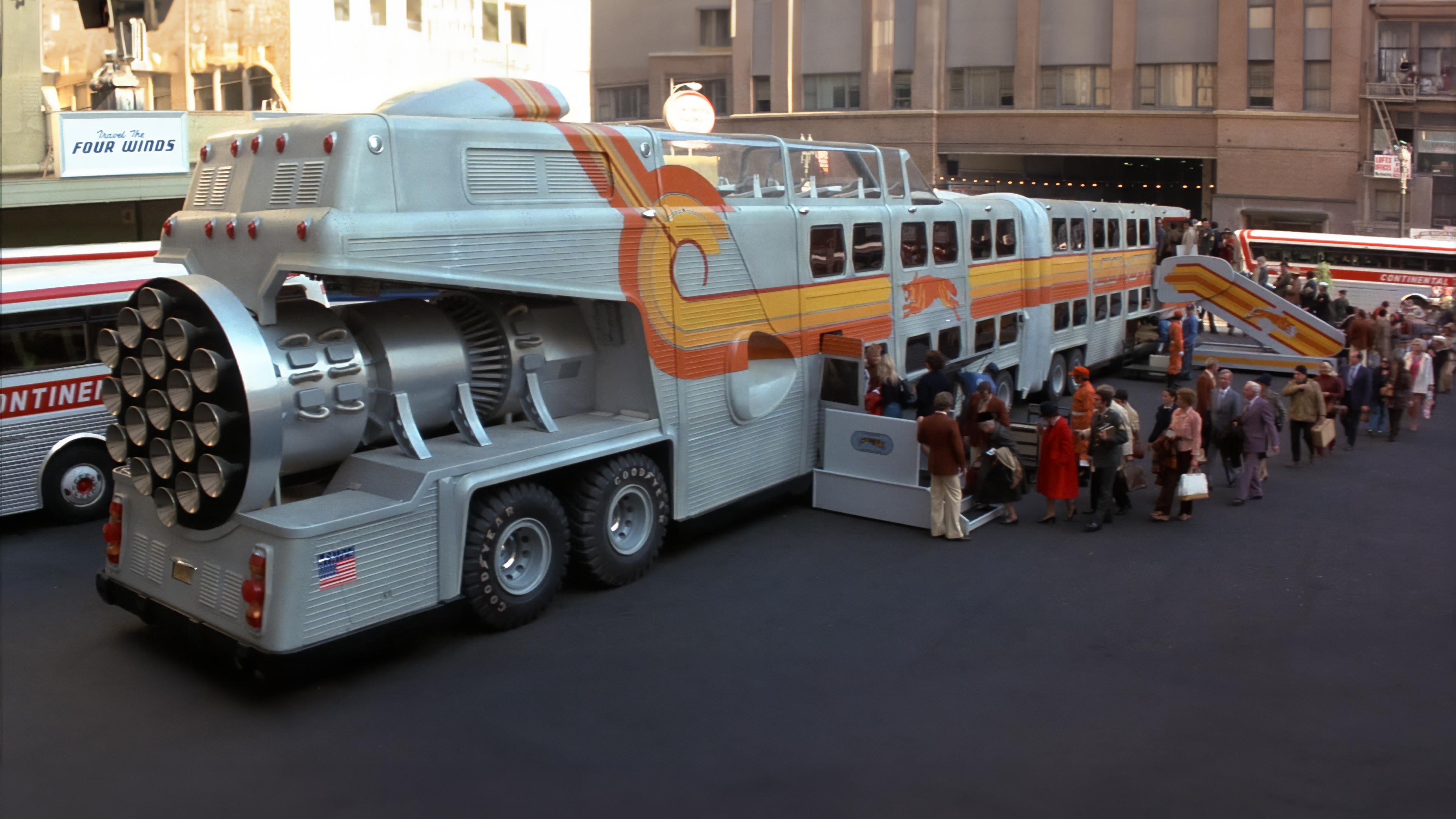
The plot follows the maiden voyage of the BB, a nuclear powered, two-story, quite long (it's essentially two passenger buses joined together) vehicle making its way, non-stop, from New York to Denver. Before the trip begins (the actual BB isn't seen for some time), there's some fiddling about with the last minute hiring of a new driver and the introduction of a Bond-style villain encased in a iron lung who is attempting, via proxy, to destroy the bus lest it reduce US dependence on Middle Eastern fuel (this is all in the wake of the 1973 oil crisis)--along the way, there are near-stops to the trip, some due to intentional sabotage, others accidents or incompetence.
Now all this is, you know, what it is: as a viewer, you can be interested in the story, find the jokes funny, the interactions engaging, or not. But it's a parody, so, in 1976, would have been seen in that light--and people didn't seem to take to it. The story is a bit of a Macguffin (for one thing, the film actually ends 25 miles from Denver which, somehow, is one of its more clever jokes), the humor fits into a few categories--
timely (or dated, if you prefer) jokes that mostly fall flat now, 47 years later; 'regular' comedy which mostly lands; or slapstick which is dependent on whether the viewer chuckles at this style of humor--and the acting is, in many cases, deliberately all over the place, with some people playing wildly broadly and others adopting the so-called 'straight-man' role as befits each scene of escalating ridiculousness.
Now here's where we get to the bit where I'm feeling like I'm part of the chorus.
If you've NOT seen the 1980 film 'Airplane!' you'll be in a similar situation to a '76 viewer and you might find it fun or whatever, but it'll be pretty much on your own terms.
However, if you HAVE seen 'Airplane!' you will find, unavoidably I think, yourself making comparisons. Looking at the films side by side, I find it is impossible to believe that Abrahams, Zucker, and Zucker had not seen BB when they wrote their film--there are just too many tonally identical scenes (and I don't mean the one lifted from the disaster movies both films are parodying). And, while the dated stuff in 'Airplane!' is still dated (and some it has crossed over into legitimately offensive), the joke rate is significantly higher (and, consequently, the hit rate is higher) and Abrahams et al incorporate a degree of surrealism--which I, personally, appreciate in comedy--that just isn't present in BB.
So, are ~you~ gonna like 'The Big Bus?' I've, frankly, no idea. Did ~I~ like it? Well, let's say I enjoyed watching it and, though it wasn't always funny, it is fascinating in a cultural context.
[Edit: I couldn't figure out how to fit this in above, but I wanted to note, somewhere, that Stockard Channing's hair having been styled to look exactly like Elizabeth Taylor's is a, um, 'choice']
I feel I've been putting off talking about 'The Big Bus' for a bit, not because I've nothing to say, but because I'm having a hard time thinking of anything 'original' to say (which is a bit of a thing on its own, as you may see).
Released in 1976 to a seemingly uninterested world (it does not appear to have set the box-office alight), 'The Big Bus' explicitly sets itself (in both the trailer and the actual film's pre title text) in line with 'The Towering Inferno,' 'Airport' & 'Airport 1975,' 'The Poseidon Adventure,' 'Earthquake,' and 'The Hindenburg,' a veritable firehose of disaster movies hitting cinemas in the 1970s. 'The Big Bus' (or BB) is a parody of those films (and others): like them, it features a location (the bus itself), a cast of passengers played by celebs of varying star power, and replicates scenes (or aspects of scenes) from its forbearers which are skewed to comic effect (or, at least, comic intent).
The plot follows the maiden voyage of the BB, a nuclear powered, two-story, quite long (it's essentially two passenger buses joined together) vehicle making its way, non-stop, from New York to Denver. Before the trip begins (the actual BB isn't seen for some time), there's some fiddling about with the last minute hiring of a new driver and the introduction of a Bond-style villain encased in a iron lung who is attempting, via proxy, to destroy the bus lest it reduce US dependence on Middle Eastern fuel (this is all in the wake of the 1973 oil crisis)--along the way, there are near-stops to the trip, some due to intentional sabotage, others accidents or incompetence.
Now all this is, you know, what it is: as a viewer, you can be interested in the story, find the jokes funny, the interactions engaging, or not. But it's a parody, so, in 1976, would have been seen in that light--and people didn't seem to take to it. The story is a bit of a Macguffin (for one thing, the film actually ends 25 miles from Denver which, somehow, is one of its more clever jokes), the humor fits into a few categories--
timely (or dated, if you prefer) jokes that mostly fall flat now, 47 years later; 'regular' comedy which mostly lands; or slapstick which is dependent on whether the viewer chuckles at this style of humor--and the acting is, in many cases, deliberately all over the place, with some people playing wildly broadly and others adopting the so-called 'straight-man' role as befits each scene of escalating ridiculousness.
Now here's where we get to the bit where I'm feeling like I'm part of the chorus.
If you've NOT seen the 1980 film 'Airplane!' you'll be in a similar situation to a '76 viewer and you might find it fun or whatever, but it'll be pretty much on your own terms.
However, if you HAVE seen 'Airplane!' you will find, unavoidably I think, yourself making comparisons. Looking at the films side by side, I find it is impossible to believe that Abrahams, Zucker, and Zucker had not seen BB when they wrote their film--there are just too many tonally identical scenes (and I don't mean the one lifted from the disaster movies both films are parodying). And, while the dated stuff in 'Airplane!' is still dated (and some it has crossed over into legitimately offensive), the joke rate is significantly higher (and, consequently, the hit rate is higher) and Abrahams et al incorporate a degree of surrealism--which I, personally, appreciate in comedy--that just isn't present in BB.
So, are ~you~ gonna like 'The Big Bus?' I've, frankly, no idea. Did ~I~ like it? Well, let's say I enjoyed watching it and, though it wasn't always funny, it is fascinating in a cultural context.
[Edit: I couldn't figure out how to fit this in above, but I wanted to note, somewhere, that Stockard Channing's hair having been styled to look exactly like Elizabeth Taylor's is a, um, 'choice']