The first thing God created was the journey, then came doubt, and nostalgia.
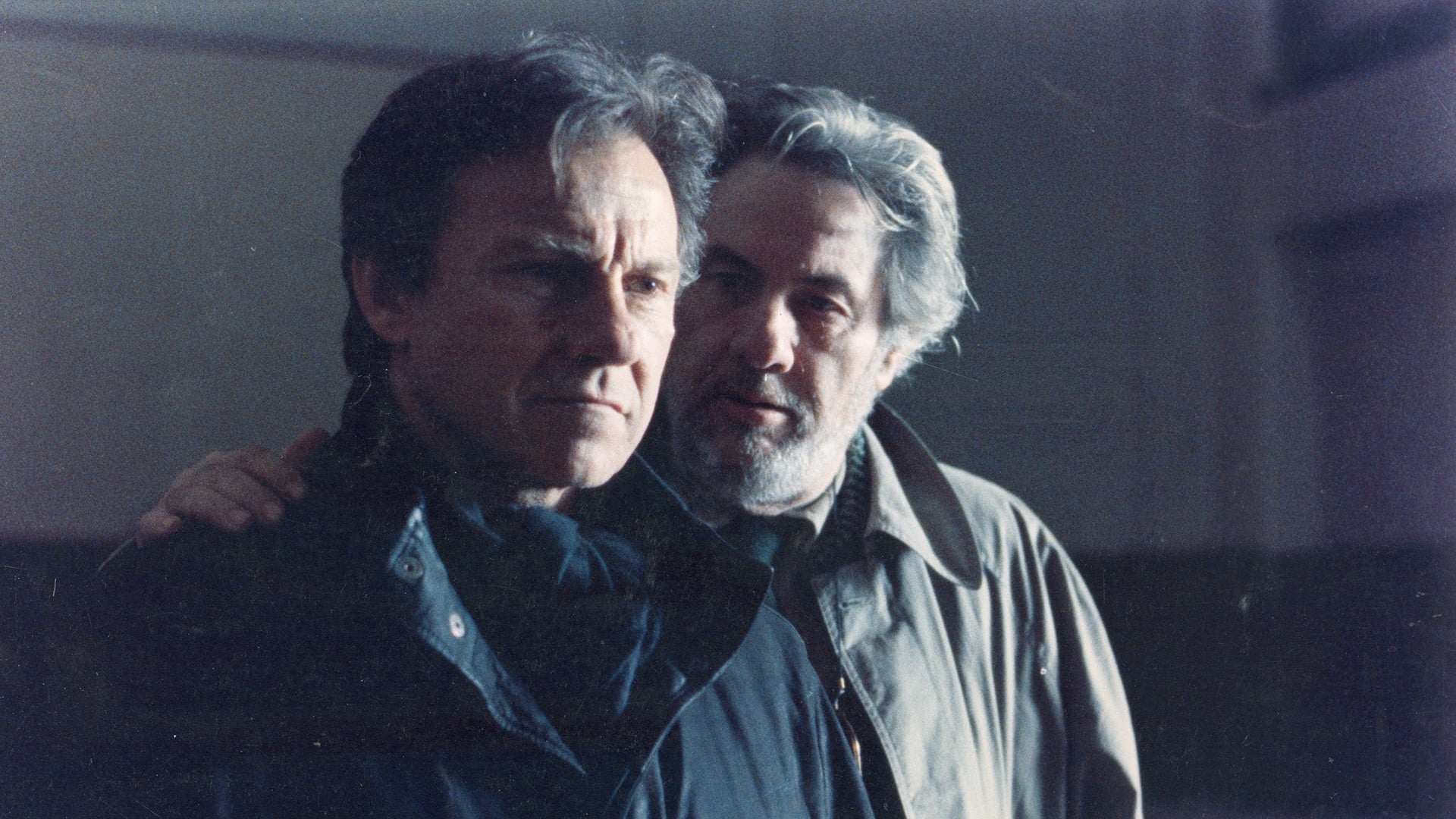
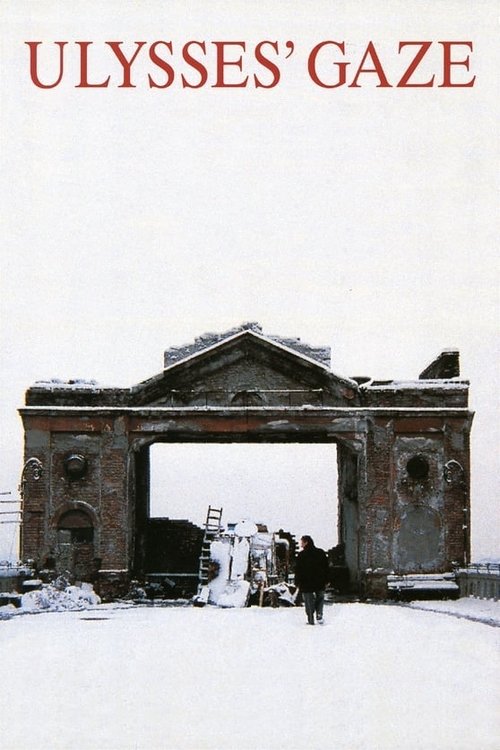
Angelopoulos's work fascinates me. I think he'll become my favorite director along with David Lynch if I continue to enjoy his filmography as much. This director, hidden in the fog of European cinema, presents here a story full of sadness and lost glances, the story of a director who embarks on a journey into nostalgia and memory, in search of three lost film reels, a love letter to cinema from one of the most brilliant filmmakers in history.
Thank you, Theo. Even though you're labeled pretentious, boring, and pedantic, you've delivered the most beautiful images I've seen in years.
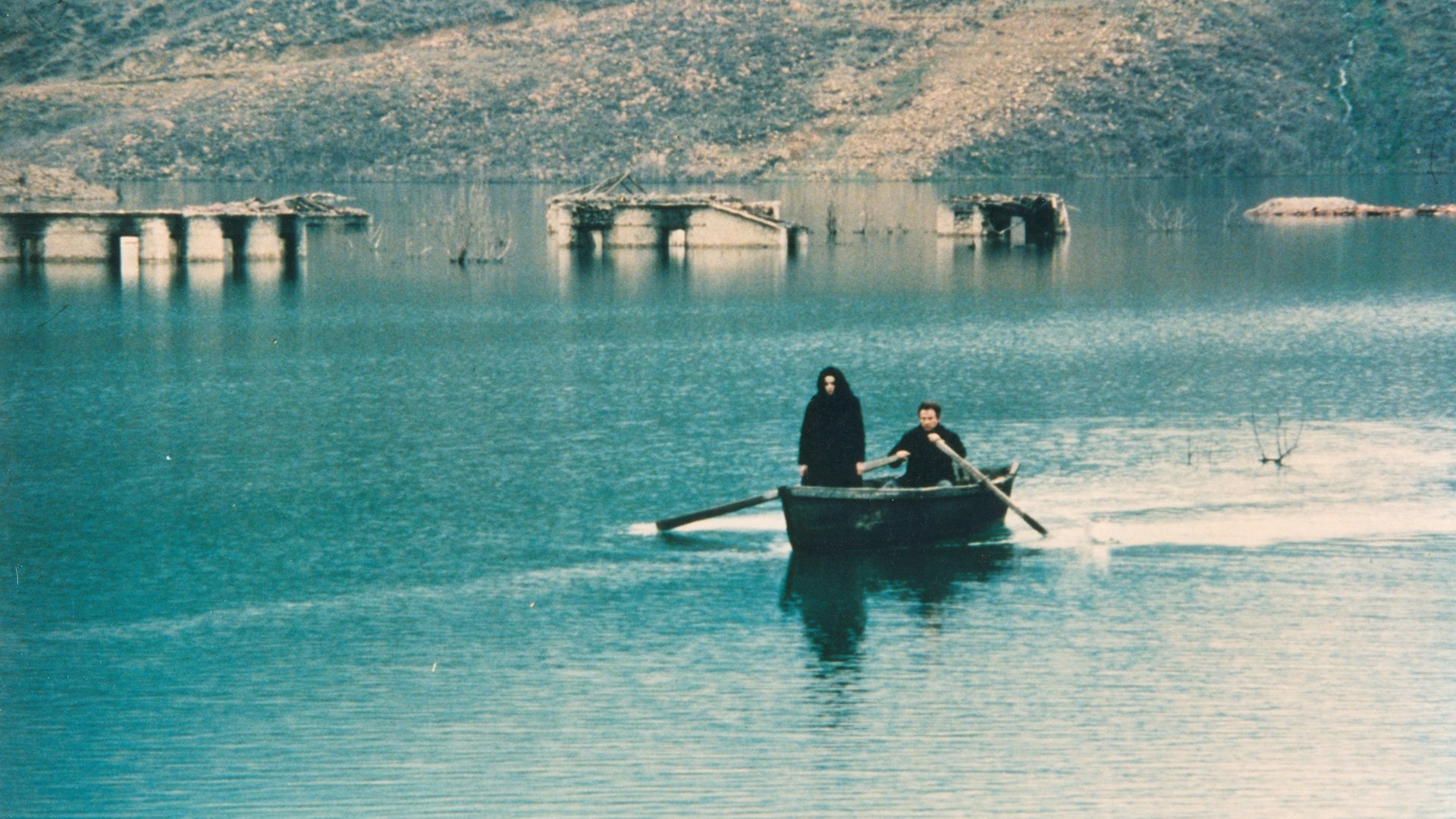
That patience of an old master, that poetry that exudes a profound love of cinema, of telling stories; you send yourself to search for those lost reels, that first glance, the innocence in those eyes, and you give us a nostalgic odyssey through memory. through the conflicts that have plagued your Balkans for over a hundred years. Few adore the image like you do, pure visuality, as a container of the idea, a transmitter of the symbolic, and a support of the poetic.
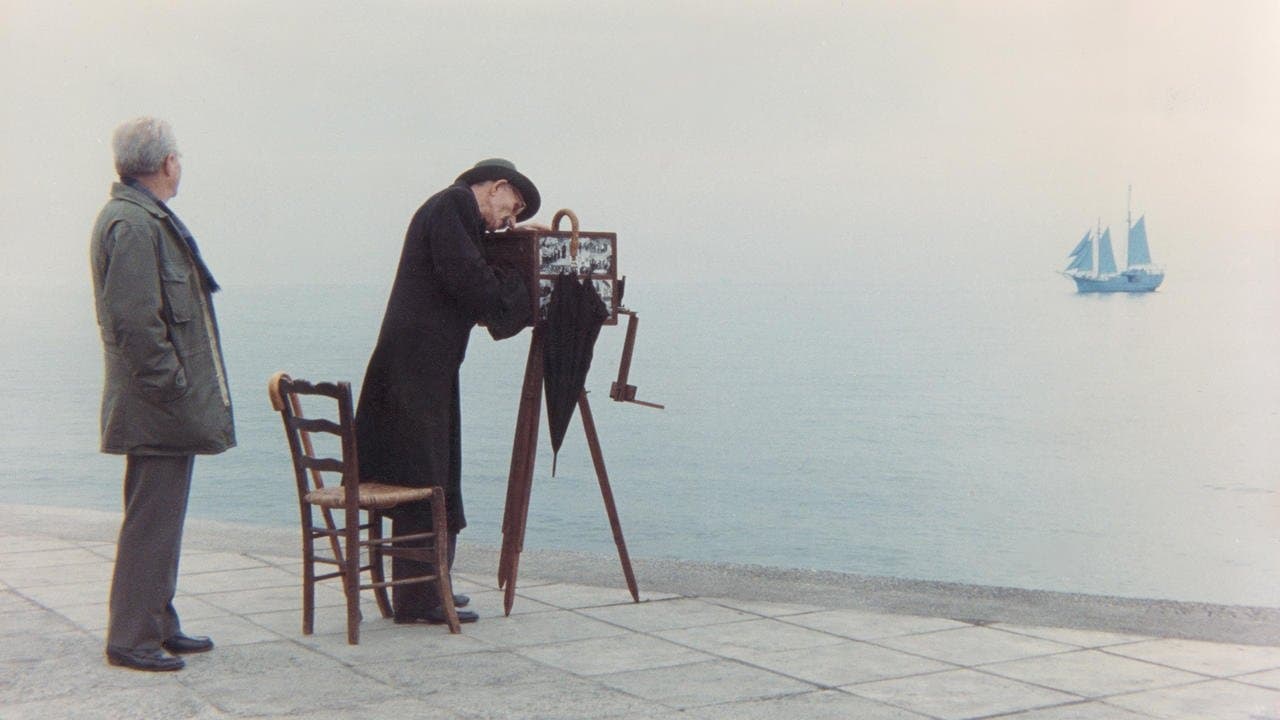
The first images of the film correspond to four shots filmed by the Manakis brothers in 1905, capturing the work of a group of spinners, and which could be the first film shot in the Balkans. But is this really the first film, the "first look" that Greek cinema casts on the world? asks the protagonist's voiceover. A fade-in leads to a sequence narrating the death of Yannakis Manakis and where A learns of the possible existence of three undeveloped reels, a film that predates the spinners' film. A short sequence but one of great narrative complexity where different temporalities meet and blend seamlessly, one of the filmmaker's hallmarks.
Thus, the material objective of the journey is proposed: to find those hypothetical reels. This is not an archaeological endeavor. What matters is not so much the discovery of a historical document as the recovery of a lost, original, supposedly innocent gaze: a possible primordial gaze on which to base a new beginning in order to avoid the disastrous mistakes made since then. The historical need to recover that gaze coincides with A's personal need to recover his own gaze, which he lost next to the Temple of Apollo, when he realized that he was incapable of understanding, that everything had ceased to make sense to him, that reality was nothing more than an immense black void, just as his camera captured it. A believes that if he recovers that original gaze from his country's cinema, he will also be able to recover his own lost gaze.
The Manakis' images are a model of the pure, uncontaminated image, whose latent state, still undeveloped, guarantees that they have not been used for any spurious purpose. A wants to recover the images of the past and search within them for a new way of understanding life.
The project, therefore, has a double dimension: it is a spatial quest following the physical path that the Manakis film may have followed, but it is also a quest in time, an inner journey of the protagonist through the imaginary topography of his memory.
***
WATCHED WITH JDGM***
Theo Angelopoulos Ranked