


2014·Thriller·2h 28m
7.1
★
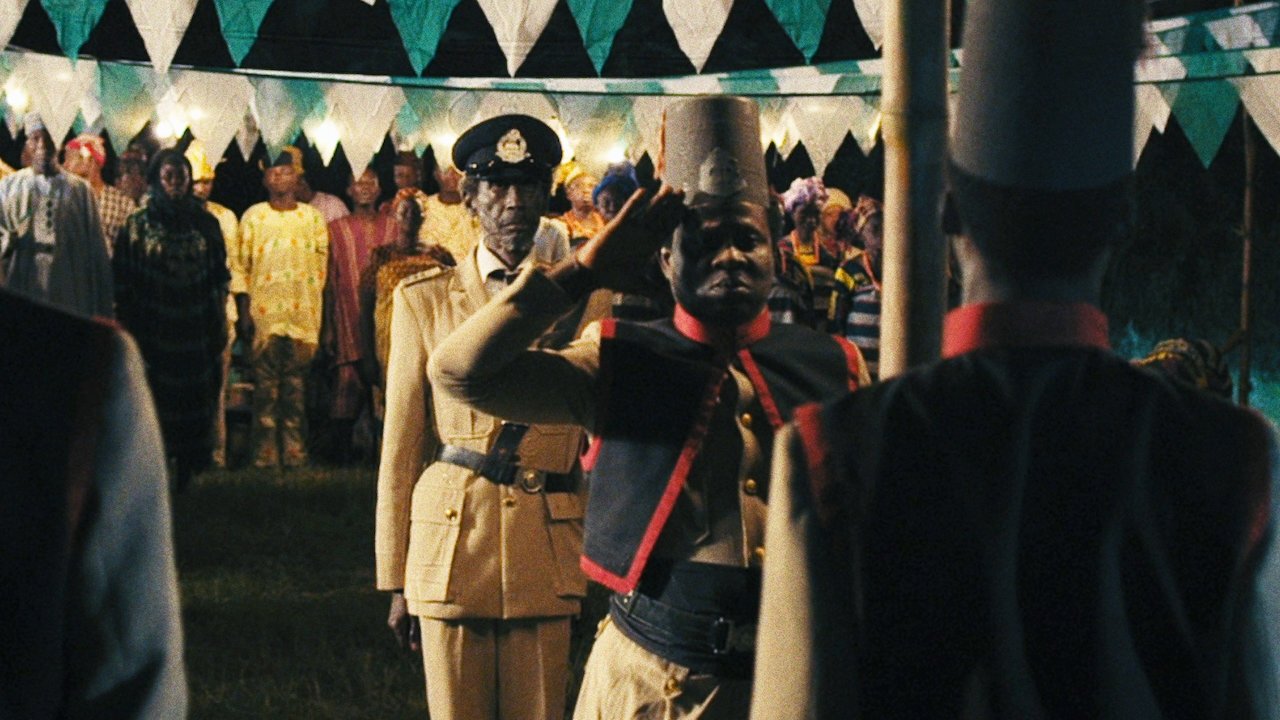
September 1960. As Nigeria prepares for independence from the British, a seasoned police detective rushes to find the serial killer slaughtering its native young women.
Directed by Kunle Afolayan
imperialism

Trailer

IMDB
N/A
Cast

Kehinde Bankole
Miss Tawa

David Bailie
Ackerman

Bimbo Manuel
Canon Kuforiji

Femi Adebayo
Banji

Kunle Afolayan
Agbekoya

Nick Rhys
Winterbottom
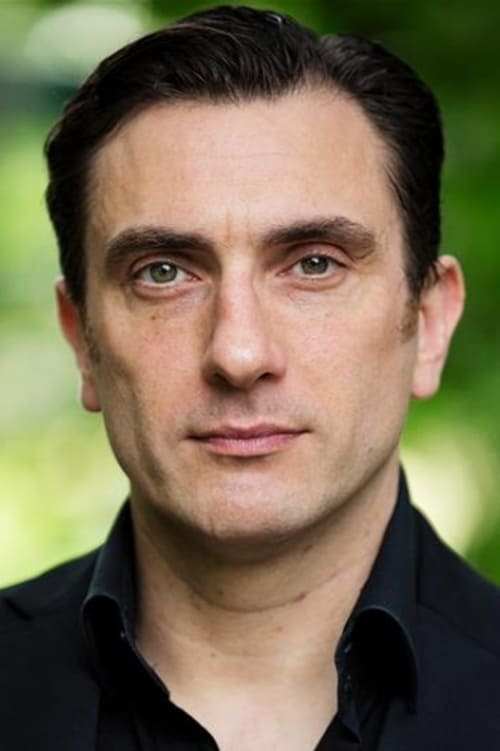
Lawrence Stubbings
Tomkins
Crew
Kunle Afolayan
Director
Kunle Afolayan
Producer
Popular Reviews
2 reviews
jamblo
7.0★ · 05/06/24
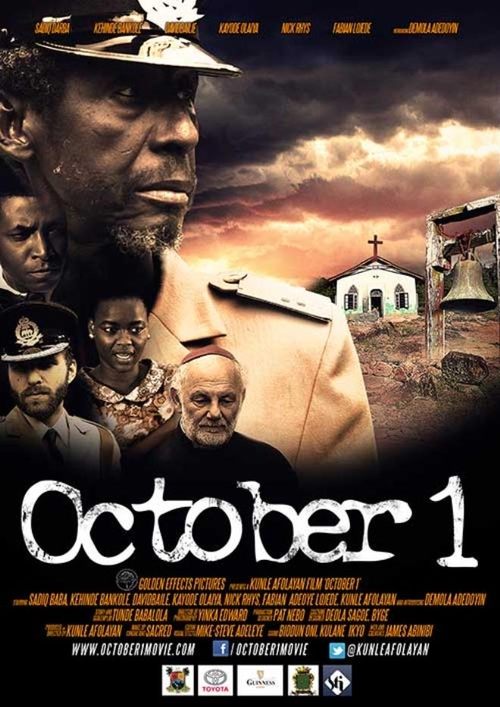
'October 1' is a long, fascinating, and occasionally frustrating watch. In brief, it is pushes 3 hours, covering an under seen (at least by me) and extremely complicated (for a variety of reasons) moment in history, and it's reach sometimes exceeds its grasp (almost entirely due, I suspect, to a combo of budget restrictions and language clashes).
The story follows a police detective who is tasked with solving a series (which grows over the course of the film) of murders in a sort of crossroads village catering to trade, in the west of Nigeria. He is given the job due to his success on a previous case (which will come back later, though not in the way you maybe are thinking) and told, by the British colonial governor (I think, I'm not entirely clear on his technical position, but you get the idea) of the region, to wrap it up, no matter what, within the four weeks leading up to Nigeria independence, the titular October 1, 1960. In addition to the escalating deaths that Inspector Waziri has to solve against this ticking clock, he also needs to navigate British racism, Nigerian tribal division, and extensive ingrained class & language barriers.
The first of the film's issue come with this last thing. Since Waziri is from a tribe in the north of the country and the village is in the west, he can't speak the local dialect nor they his (and, of course, the Brits don't understand anything) which means that the only common language is English and, while this makes narrative sense and is likely at least somewhat historically accurate, the film struggles with it because many of the actors are also clearly struggling with, not only English pronunciation (again, not faulting them), but also usage and inflection which results in often very stilted and unnatural delivery, creating comedy where there should be none or confusion as to what, exactly, is going on. I am fully aware that this me speaking as an English speaker and that, in all likelihood, the same is true in other films when English-speaking actors perform in languages other than their own. None the less, it is very jarring here.
To get the film's other main problem out of the way quickly--I'm feeling bad about how much complaining I'm doing about a movie I actually liked quite a bit--there are budget visible budget constraints all over the place. These include what appear to be several insert shots (perhaps reshoots) noticeably on videotape unlike the rest of the film, there are sequences that clearly needed ADR which didn't happen leaving dialogue buried in ambient noise, and the color correction is all over the place. Script-wise, there are a lot of topics trying to be covered: in addition to the colonialism, independence, racism, tribal relations, and class conflict mention above, it also wants to discuss religious oppression, pedophilia within the church, government suppression, personal and collective guilt, sexual violence, and, well, the birth pains of a new country--it's a lot to cram into even two hours and forty five minutes. Also, the acting quality is pretty varied, though this may be due to the pool of extras not being as deep as that of countries with a more established film industry.
Ok, let's move on to the good stuff. In no special order (except the first one):
On the whole, it is really a pretty impressive work.
The story follows a police detective who is tasked with solving a series (which grows over the course of the film) of murders in a sort of crossroads village catering to trade, in the west of Nigeria. He is given the job due to his success on a previous case (which will come back later, though not in the way you maybe are thinking) and told, by the British colonial governor (I think, I'm not entirely clear on his technical position, but you get the idea) of the region, to wrap it up, no matter what, within the four weeks leading up to Nigeria independence, the titular October 1, 1960. In addition to the escalating deaths that Inspector Waziri has to solve against this ticking clock, he also needs to navigate British racism, Nigerian tribal division, and extensive ingrained class & language barriers.
The first of the film's issue come with this last thing. Since Waziri is from a tribe in the north of the country and the village is in the west, he can't speak the local dialect nor they his (and, of course, the Brits don't understand anything) which means that the only common language is English and, while this makes narrative sense and is likely at least somewhat historically accurate, the film struggles with it because many of the actors are also clearly struggling with, not only English pronunciation (again, not faulting them), but also usage and inflection which results in often very stilted and unnatural delivery, creating comedy where there should be none or confusion as to what, exactly, is going on. I am fully aware that this me speaking as an English speaker and that, in all likelihood, the same is true in other films when English-speaking actors perform in languages other than their own. None the less, it is very jarring here.
To get the film's other main problem out of the way quickly--I'm feeling bad about how much complaining I'm doing about a movie I actually liked quite a bit--there are budget visible budget constraints all over the place. These include what appear to be several insert shots (perhaps reshoots) noticeably on videotape unlike the rest of the film, there are sequences that clearly needed ADR which didn't happen leaving dialogue buried in ambient noise, and the color correction is all over the place. Script-wise, there are a lot of topics trying to be covered: in addition to the colonialism, independence, racism, tribal relations, and class conflict mention above, it also wants to discuss religious oppression, pedophilia within the church, government suppression, personal and collective guilt, sexual violence, and, well, the birth pains of a new country--it's a lot to cram into even two hours and forty five minutes. Also, the acting quality is pretty varied, though this may be due to the pool of extras not being as deep as that of countries with a more established film industry.
Ok, let's move on to the good stuff. In no special order (except the first one):
Sadiq Daba's performance as Waziri is very, very good. He absolutely nails the physical attributes of the character and, even when the language gets in the way, maintains the necessary essence of the dialogue. I really want to see something of his where he acts more in Hausa than English--there's a palpable power in the one scene where he does this here. Also, as a side note, his hands are quite fascinating (what do you want, the camera knows it, too). I'm sad to see that he died only a couple of years ago (2021).
There is no fault in director Kunle Afolayan's ambition and, particularly given the film's reportedly paltry (at least for a historical epic) $2million budget, the degree to which he is able to carry the audience along is incredibly impressive. Barring the issues above (and the odd historical inaccuracy), the film is a case study in getting the most for your money.
The script, by Tunde Babalola, while I think being guilty of overstuffing to a degree, is genuinely intriguing in how it uses the murder investigation as a springboard to explore the growing pains of nationhood and, not knowing much about the topic specific to Nigeria, it was really interesting. Also worth mentioning is that the film is not really a whodunnit--if you don't have an idea of the killer pretty early that's fine, but if you do, that's also fine as the story is more interested in the circumstances that allow this happen, rather than the mystery angle.
And, though I would critique some of the other acting (for the above reasons), somehow there is still a great sense of collective enthusiasm on display--it feels as though everyone is doing their best to pull off this remarkable complex project of putting together a film, first, and second, a film that doesn't candy coat or otherwise diminish the past, but rather lay bare some uncomfortable truths even under the larger evil of colonialism.
On the whole, it is really a pretty impressive work.
'October 1' is a long, fascinating, and occasionally frustrating watch. In brief, it is pushes 3 hours, covering an under seen (at least by me) and extremely complicated (for a variety of reasons) moment in history, and it's reach sometimes exceeds its grasp (almost entirely due, I suspect, to a combo of budget restrictions and language clashes).
The story follows a police detective who is tasked with solving a series (which grows over the course of the film) of murders in a sort of crossroads village catering to trade, in the west of Nigeria. He is given the job due to his success on a previous case (which will come back later, though not in the way you maybe are thinking) and told, by the British colonial governor (I think, I'm not entirely clear on his technical position, but you get the idea) of the region, to wrap it up, no matter what, within the four weeks leading up to Nigeria independence, the titular October 1, 1960. In addition to the escalating deaths that Inspector Waziri has to solve against this ticking clock, he also needs to navigate British racism, Nigerian tribal division, and extensive ingrained class & language barriers.
The first of the film's issue come with this last thing. Since Waziri is from a tribe in the north of the country and the village is in the west, he can't speak the local dialect nor they his (and, of course, the Brits don't understand anything) which means that the only common language is English and, while this makes narrative sense and is likely at least somewhat historically accurate, the film struggles with it because many of the actors are also clearly struggling with, not only English pronunciation (again, not faulting them), but also usage and inflection which results in often very stilted and unnatural delivery, creating comedy where there should be none or confusion as to what, exactly, is going on. I am fully aware that this me speaking as an English speaker and that, in all likelihood, the same is true in other films when English-speaking actors perform in languages other than their own. None the less, it is very jarring here.
To get the film's other main problem out of the way quickly--I'm feeling bad about how much complaining I'm doing about a movie I actually liked quite a bit--there are budget visible budget constraints all over the place. These include what appear to be several insert shots (perhaps reshoots) noticeably on videotape unlike the rest of the film, there are sequences that clearly needed ADR which didn't happen leaving dialogue buried in ambient noise, and the color correction is all over the place. Script-wise, there are a lot of topics trying to be covered: in addition to the colonialism, independence, racism, tribal relations, and class conflict mention above, it also wants to discuss religious oppression, pedophilia within the church, government suppression, personal and collective guilt, sexual violence, and, well, the birth pains of a new country--it's a lot to cram into even two hours and forty five minutes. Also, the acting quality is pretty varied, though this may be due to the pool of extras not being as deep as that of countries with a more established film industry.
Ok, let's move on to the good stuff. In no special order (except the first one):
On the whole, it is really a pretty impressive work.
The story follows a police detective who is tasked with solving a series (which grows over the course of the film) of murders in a sort of crossroads village catering to trade, in the west of Nigeria. He is given the job due to his success on a previous case (which will come back later, though not in the way you maybe are thinking) and told, by the British colonial governor (I think, I'm not entirely clear on his technical position, but you get the idea) of the region, to wrap it up, no matter what, within the four weeks leading up to Nigeria independence, the titular October 1, 1960. In addition to the escalating deaths that Inspector Waziri has to solve against this ticking clock, he also needs to navigate British racism, Nigerian tribal division, and extensive ingrained class & language barriers.
The first of the film's issue come with this last thing. Since Waziri is from a tribe in the north of the country and the village is in the west, he can't speak the local dialect nor they his (and, of course, the Brits don't understand anything) which means that the only common language is English and, while this makes narrative sense and is likely at least somewhat historically accurate, the film struggles with it because many of the actors are also clearly struggling with, not only English pronunciation (again, not faulting them), but also usage and inflection which results in often very stilted and unnatural delivery, creating comedy where there should be none or confusion as to what, exactly, is going on. I am fully aware that this me speaking as an English speaker and that, in all likelihood, the same is true in other films when English-speaking actors perform in languages other than their own. None the less, it is very jarring here.
To get the film's other main problem out of the way quickly--I'm feeling bad about how much complaining I'm doing about a movie I actually liked quite a bit--there are budget visible budget constraints all over the place. These include what appear to be several insert shots (perhaps reshoots) noticeably on videotape unlike the rest of the film, there are sequences that clearly needed ADR which didn't happen leaving dialogue buried in ambient noise, and the color correction is all over the place. Script-wise, there are a lot of topics trying to be covered: in addition to the colonialism, independence, racism, tribal relations, and class conflict mention above, it also wants to discuss religious oppression, pedophilia within the church, government suppression, personal and collective guilt, sexual violence, and, well, the birth pains of a new country--it's a lot to cram into even two hours and forty five minutes. Also, the acting quality is pretty varied, though this may be due to the pool of extras not being as deep as that of countries with a more established film industry.
Ok, let's move on to the good stuff. In no special order (except the first one):
Sadiq Daba's performance as Waziri is very, very good. He absolutely nails the physical attributes of the character and, even when the language gets in the way, maintains the necessary essence of the dialogue. I really want to see something of his where he acts more in Hausa than English--there's a palpable power in the one scene where he does this here. Also, as a side note, his hands are quite fascinating (what do you want, the camera knows it, too). I'm sad to see that he died only a couple of years ago (2021).
There is no fault in director Kunle Afolayan's ambition and, particularly given the film's reportedly paltry (at least for a historical epic) $2million budget, the degree to which he is able to carry the audience along is incredibly impressive. Barring the issues above (and the odd historical inaccuracy), the film is a case study in getting the most for your money.
The script, by Tunde Babalola, while I think being guilty of overstuffing to a degree, is genuinely intriguing in how it uses the murder investigation as a springboard to explore the growing pains of nationhood and, not knowing much about the topic specific to Nigeria, it was really interesting. Also worth mentioning is that the film is not really a whodunnit--if you don't have an idea of the killer pretty early that's fine, but if you do, that's also fine as the story is more interested in the circumstances that allow this happen, rather than the mystery angle.
And, though I would critique some of the other acting (for the above reasons), somehow there is still a great sense of collective enthusiasm on display--it feels as though everyone is doing their best to pull off this remarkable complex project of putting together a film, first, and second, a film that doesn't candy coat or otherwise diminish the past, but rather lay bare some uncomfortable truths even under the larger evil of colonialism.
On the whole, it is really a pretty impressive work.


Racheal
8.0★ · 12/24/24