For a hang-out movie to quote work unquote, I think it needs at least one of a few things: the characters must be entertaining (you need to be invested in watching them have a good (or otherwise) time), the setting must be distinctive (or otherwise notable to the viewer), the film must be visually striking in some (really, any) way, or there must be something going on with regards to the soundtrack that you find appealing.
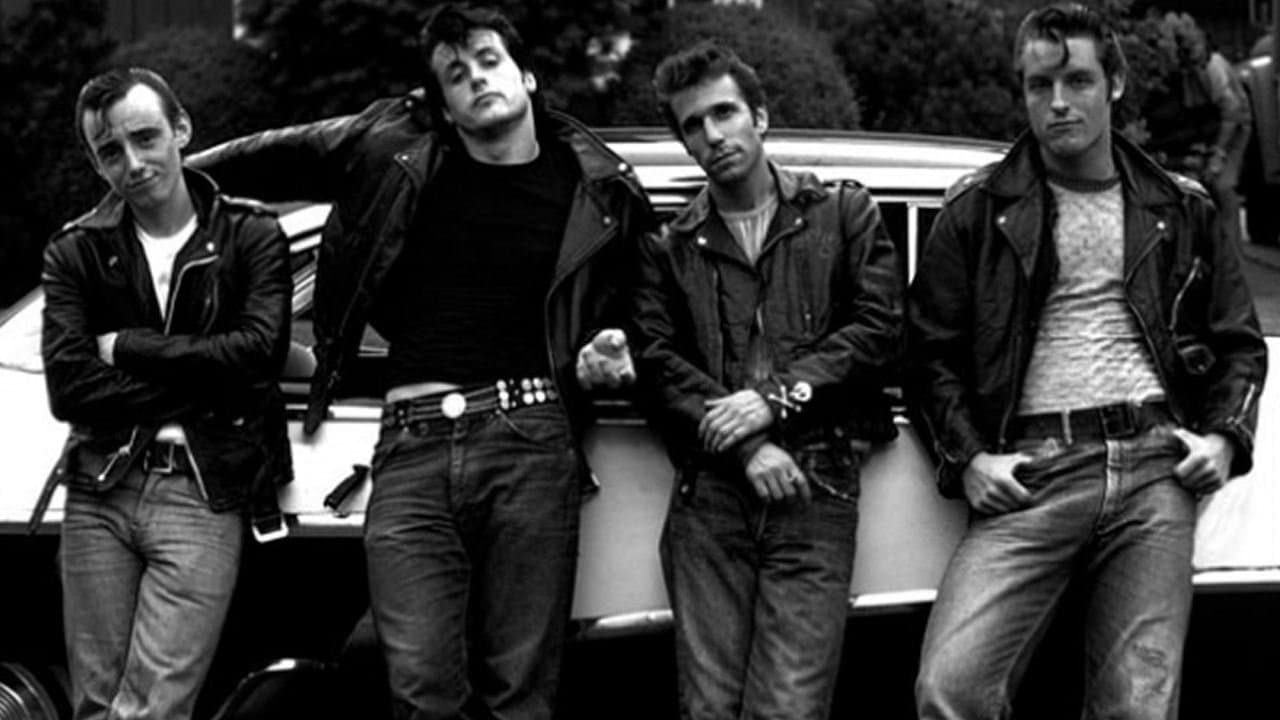
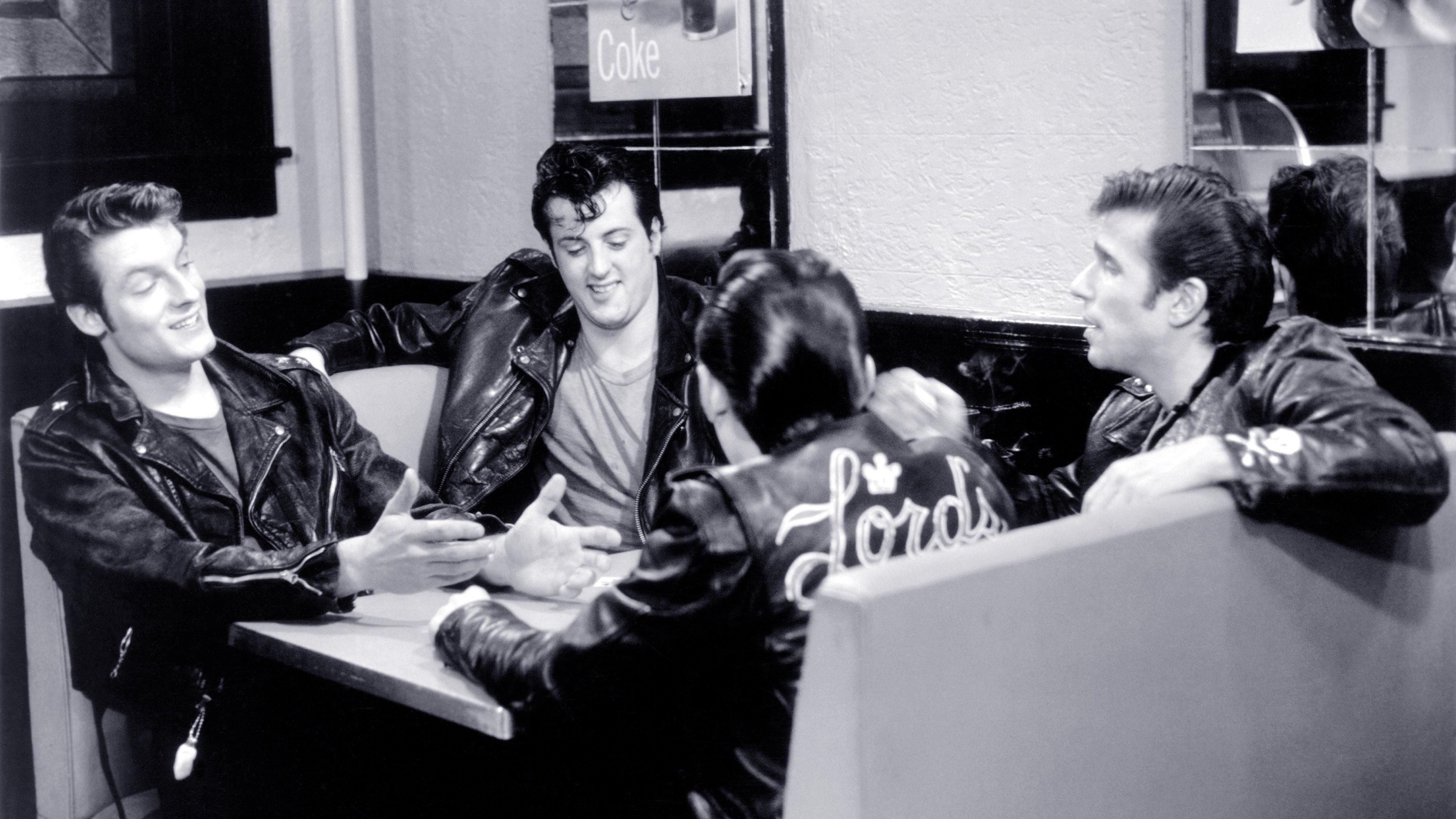
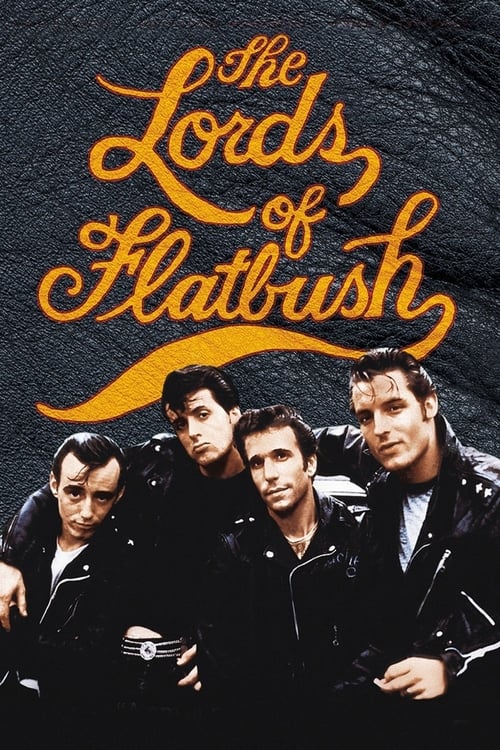
'Lords of Flatbush' (or, as it appears on the backs of the leather-jacketed main characters, 'Lord's of Flatbush') is most definitely a hang-out movie. The film is constructed, almost entirely, of disjointed scenes with one or more of the four leads—other than, possibly, a pregnancy scare scene and then a scene of buying an engagement ring and, later, a wedding, there is entirely no need for the scenes to appear in the order that they do. There is no through narrative (the lack of which is, admittedly, a hallmark of the genre).
Using myself as a test case (because, well, I don’t know you), I grew up in the US, in the 1970s and, as so, was 'treated' to that era's inexplicable fascination with 1950s greaser subculture, which included (and perhaps began with) the music group Sha Na Na performing at Woodstock in 1969, continued with the stage production of 'Grease' in 1971, was referenced in 1973's 'American Graffiti,' and continued with the TV show 'Happy Days' (which ran from 1974 to 1984) and its subsequent spin-offs, and reached its probable apex with the film version of 'Grease' in 1978. Point being, the 1970s were swimming in watered-down, rose-tinted, milquetoast '50s nostalgia and I hated it (never saw 'Grease,' but was hyper aware of it)—none of this stuff seemed 'cool' to me, I despised the music, didn't like the clothes, and recognized, even then, that the 'attitude' was nothing more than lame a put on. I didn't see 'Lords of Flatbush' at the time (though I could have, as it was rated PG), but it presents a kind of an interesting case as it was filmed in 1973 (released in 1974), before 'Happy Days' but starring (nominally, as it happens) Henry Winkler as someone very like his 'Happy Days' character, Fonzie. One would not be mistaken in considering this film as the immediate precursor (though not originator) to the stratospheric launch of the Greaser boom.
So, what's it like, you ask?
Well, let's look at the aforementioned list of hang necessities.
• First, the four male leads (the actors were all in the mid-20s playing, ostensibly, teens and all utterly failing) are all complete dicks. All are the epitome of the 'high school bully trope,' and are misogynist, mean, stupid, and insufferable. Even if you try and approach the story as being about 'boys trying to find themselves and their place in the world,' these four idiots should just be expelled from school whereupon a couple would probably go on to die in Korea (or, later, Vietnam), one would probably end in jail for spousal abuse, and one (the 'successful' one) would likely move to Staten Island and go bankrupt operating a used furniture store.
• Second, the setting: I live near Flatbush, I'm on it a lot, and I thought, well, that'll be interesting to see the neighborhood in the 1970s pretending to be the 50s, right? Wrong. It's mostly filmed in Queens and Coney Island. So never mind.
• Third, visual appeal: ok, this film is admittedly visually unusual, but when I said that above, I meant that it should be interesting: this film is too dark, horribly edited, and half of it is literally out of focus (which does not appear to be the result of the streaming service, as contemporary reviews mention it as well).
• Fourth, the music: I’ve kind of come around to some (not a lot, but some) 'early' rock & roll and doo wop music and, if this film had had the budget to do the jukebox thing that 'American Graffiti' did, there likely would have been something tolerable. But instead, the filmmakers seem to have mostly used original songs written in the style of doo wop and, while I’m sure Joe Brooks was a lovely guy, these songs just suck. A lot.
There are three credited scriptwriters (as well as Sylvester Stallone with an 'additional dialogue' credit) but most of the scenes appear to very poorly improvised (witness the scene with Perry King, Winkler, and Renee Paris in the diner which is just interminable with King giggling to himself while the camera keeps cutting to Winkler as if in the hopes that he'll say something, just anything) and at 85 minutes, the film feels at least twice as long.
The only two worthwhile scenes both feature Stallone (and, presumably, were written by him as the dialogue sounds noticeably different): one, the aforementioned ring-buying scene where the male character's ludicrous machismo is ground away by the hectoring of Maria Smith (who is far and away the best actor in this entire mess) and her best friend, the aforementioned Paris, and the second, a weird bit set in a rooftop pigeon coop where Stallone tries to get King to put himself in the mindset of flying like a bird, but both are so stilted that Stallone sounds insane and King sounds utterly incapable of even the most minor imaginative leap.
I’m sorry, but it's just terrible (the half star is just for Smith).
For a hang-out movie to quote work unquote, I think it needs at least one of a few things: the characters must be entertaining (you need to be invested in watching them have a good (or otherwise) time), the setting must be distinctive (or otherwise notable to the viewer), the film must be visually striking in some (really, any) way, or there must be something going on with regards to the soundtrack that you find appealing.
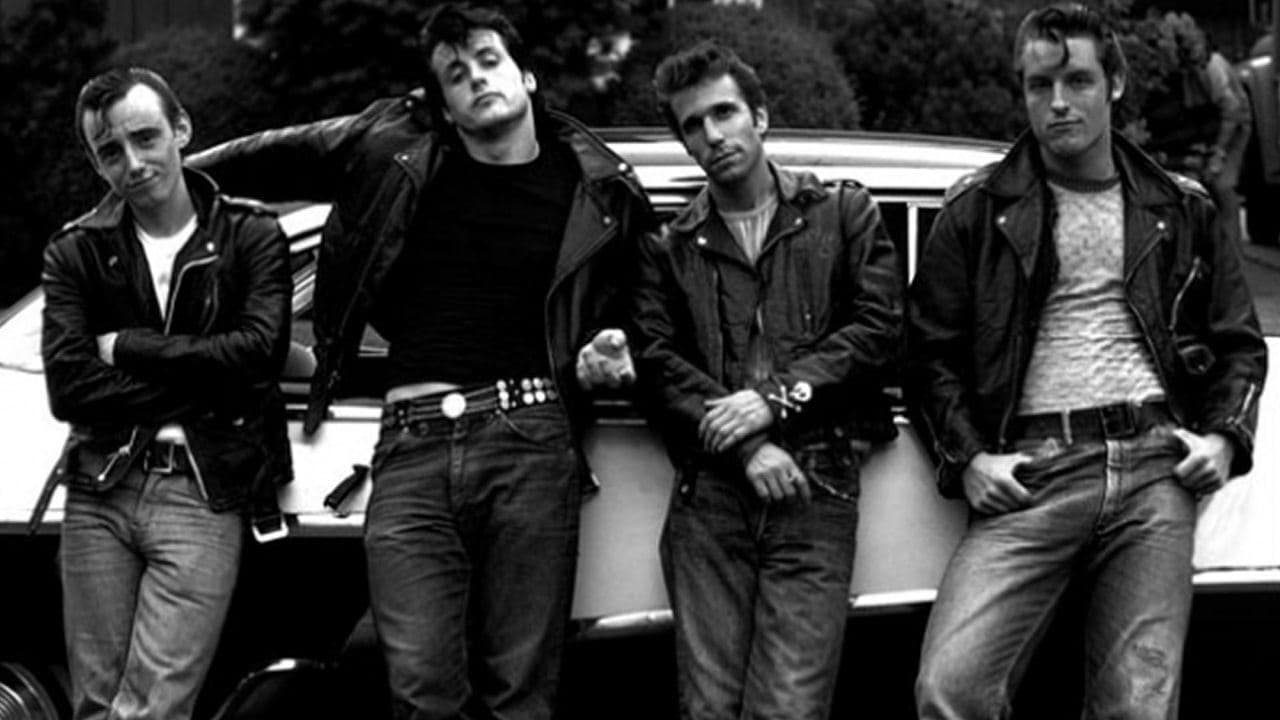
'Lords of Flatbush' (or, as it appears on the backs of the leather-jacketed main characters, 'Lord's of Flatbush') is most definitely a hang-out movie. The film is constructed, almost entirely, of disjointed scenes with one or more of the four leads—other than, possibly, a pregnancy scare scene and then a scene of buying an engagement ring and, later, a wedding, there is entirely no need for the scenes to appear in the order that they do. There is no through narrative (the lack of which is, admittedly, a hallmark of the genre).
Using myself as a test case (because, well, I don’t know you), I grew up in the US, in the 1970s and, as so, was 'treated' to that era's inexplicable fascination with 1950s greaser subculture, which included (and perhaps began with) the music group Sha Na Na performing at Woodstock in 1969, continued with the stage production of 'Grease' in 1971, was referenced in 1973's 'American Graffiti,' and continued with the TV show 'Happy Days' (which ran from 1974 to 1984) and its subsequent spin-offs, and reached its probable apex with the film version of 'Grease' in 1978. Point being, the 1970s were swimming in watered-down, rose-tinted, milquetoast '50s nostalgia and I hated it (never saw 'Grease,' but was hyper aware of it)—none of this stuff seemed 'cool' to me, I despised the music, didn't like the clothes, and recognized, even then, that the 'attitude' was nothing more than lame a put on. I didn't see 'Lords of Flatbush' at the time (though I could have, as it was rated PG), but it presents a kind of an interesting case as it was filmed in 1973 (released in 1974), before 'Happy Days' but starring (nominally, as it happens) Henry Winkler as someone very like his 'Happy Days' character, Fonzie. One would not be mistaken in considering this film as the immediate precursor (though not originator) to the stratospheric launch of the Greaser boom.
So, what's it like, you ask?
Well, let's look at the aforementioned list of hang necessities.
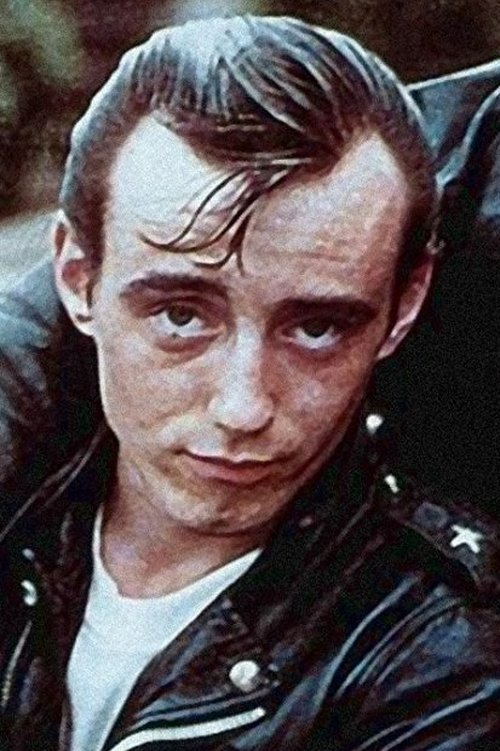
• First, the four male leads (the actors were all in the mid-20s playing, ostensibly, teens and all utterly failing) are all complete dicks. All are the epitome of the 'high school bully trope,' and are misogynist, mean, stupid, and insufferable. Even if you try and approach the story as being about 'boys trying to find themselves and their place in the world,' these four idiots should just be expelled from school whereupon a couple would probably go on to die in Korea (or, later, Vietnam), one would probably end in jail for spousal abuse, and one (the 'successful' one) would likely move to Staten Island and go bankrupt operating a used furniture store.
• Second, the setting: I live near Flatbush, I'm on it a lot, and I thought, well, that'll be interesting to see the neighborhood in the 1970s pretending to be the 50s, right? Wrong. It's mostly filmed in Queens and Coney Island. So never mind.
• Third, visual appeal: ok, this film is admittedly visually unusual, but when I said that above, I meant that it should be interesting: this film is too dark, horribly edited, and half of it is literally out of focus (which does not appear to be the result of the streaming service, as contemporary reviews mention it as well).
• Fourth, the music: I’ve kind of come around to some (not a lot, but some) 'early' rock & roll and doo wop music and, if this film had had the budget to do the jukebox thing that 'American Graffiti' did, there likely would have been something tolerable. But instead, the filmmakers seem to have mostly used original songs written in the style of doo wop and, while I’m sure Joe Brooks was a lovely guy, these songs just suck. A lot.
There are three credited scriptwriters (as well as Sylvester Stallone with an 'additional dialogue' credit) but most of the scenes appear to very poorly improvised (witness the scene with Perry King, Winkler, and Renee Paris in the diner which is just interminable with King giggling to himself while the camera keeps cutting to Winkler as if in the hopes that he'll say something, just anything) and at 85 minutes, the film feels at least twice as long.
The only two worthwhile scenes both feature Stallone (and, presumably, were written by him as the dialogue sounds noticeably different): one, the aforementioned ring-buying scene where the male character's ludicrous machismo is ground away by the hectoring of Maria Smith (who is far and away the best actor in this entire mess) and her best friend, the aforementioned Paris, and the second, a weird bit set in a rooftop pigeon coop where Stallone tries to get King to put himself in the mindset of flying like a bird, but both are so stilted that Stallone sounds insane and King sounds utterly incapable of even the most minor imaginative leap.
I’m sorry, but it's just terrible (the half star is just for Smith).