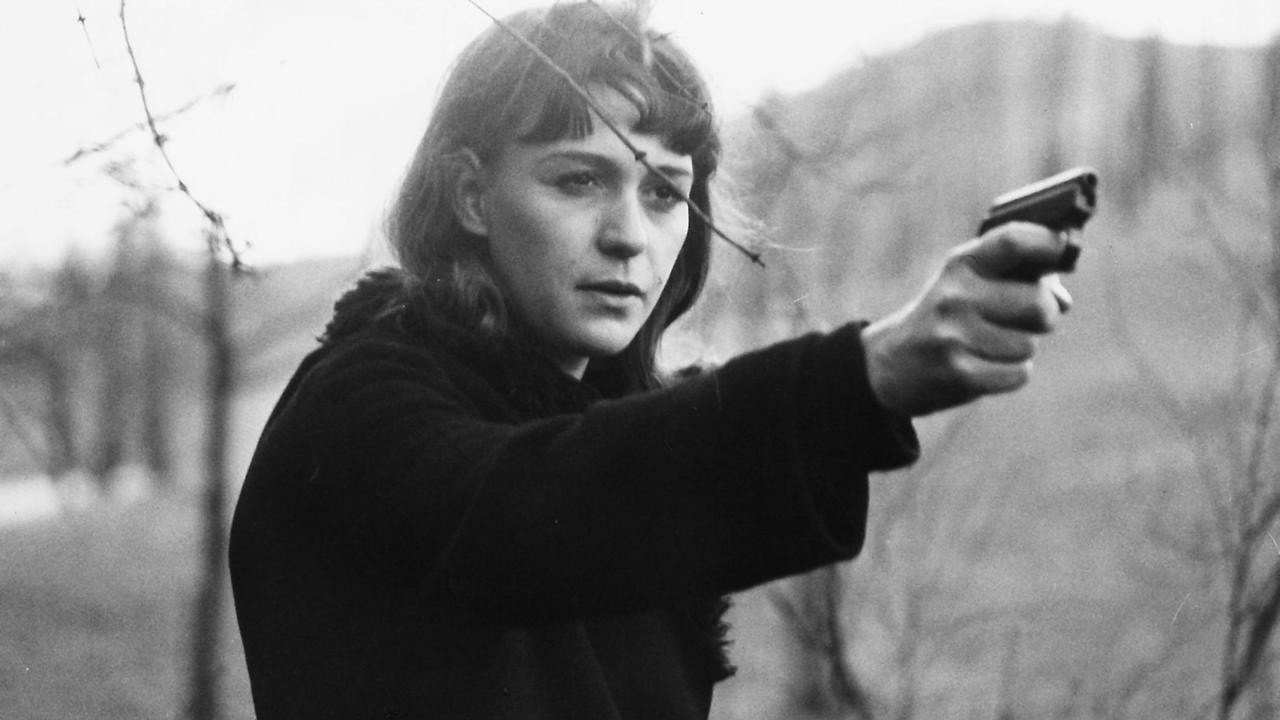
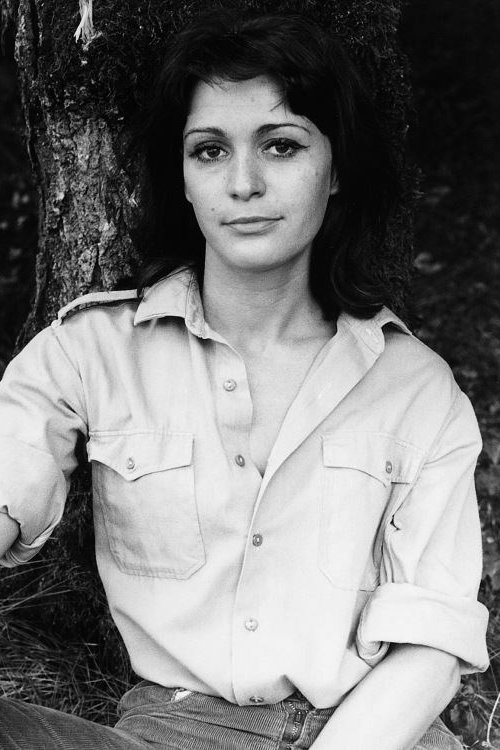
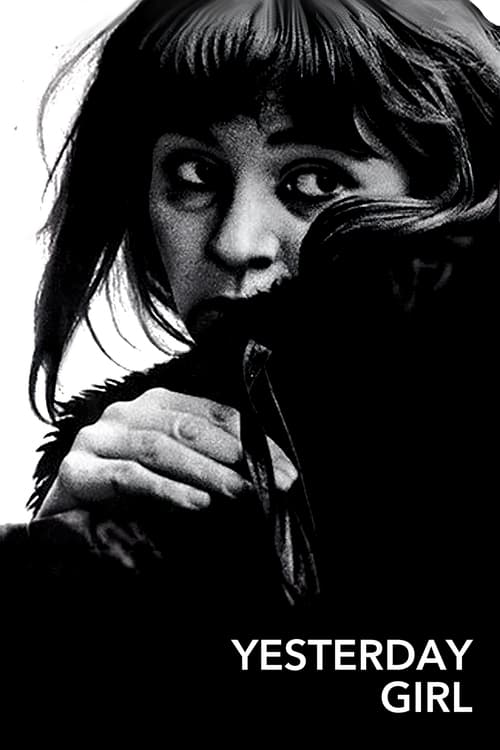
Yesterday Girl is of the type of film I find myself often encountering. By that I mean that the earnestness and honesty which I try to use to inform my rating assimilates among a mass of other works, a film which is absolutely brilliant. Despite its rating,
Yesterday Girl remains a sumptuously experimental, thematically dense, and captivating presentation of a society in denial, of a guilt more easily forgotten than confronted, even when its physical embodiment is staring you in the face. So much about
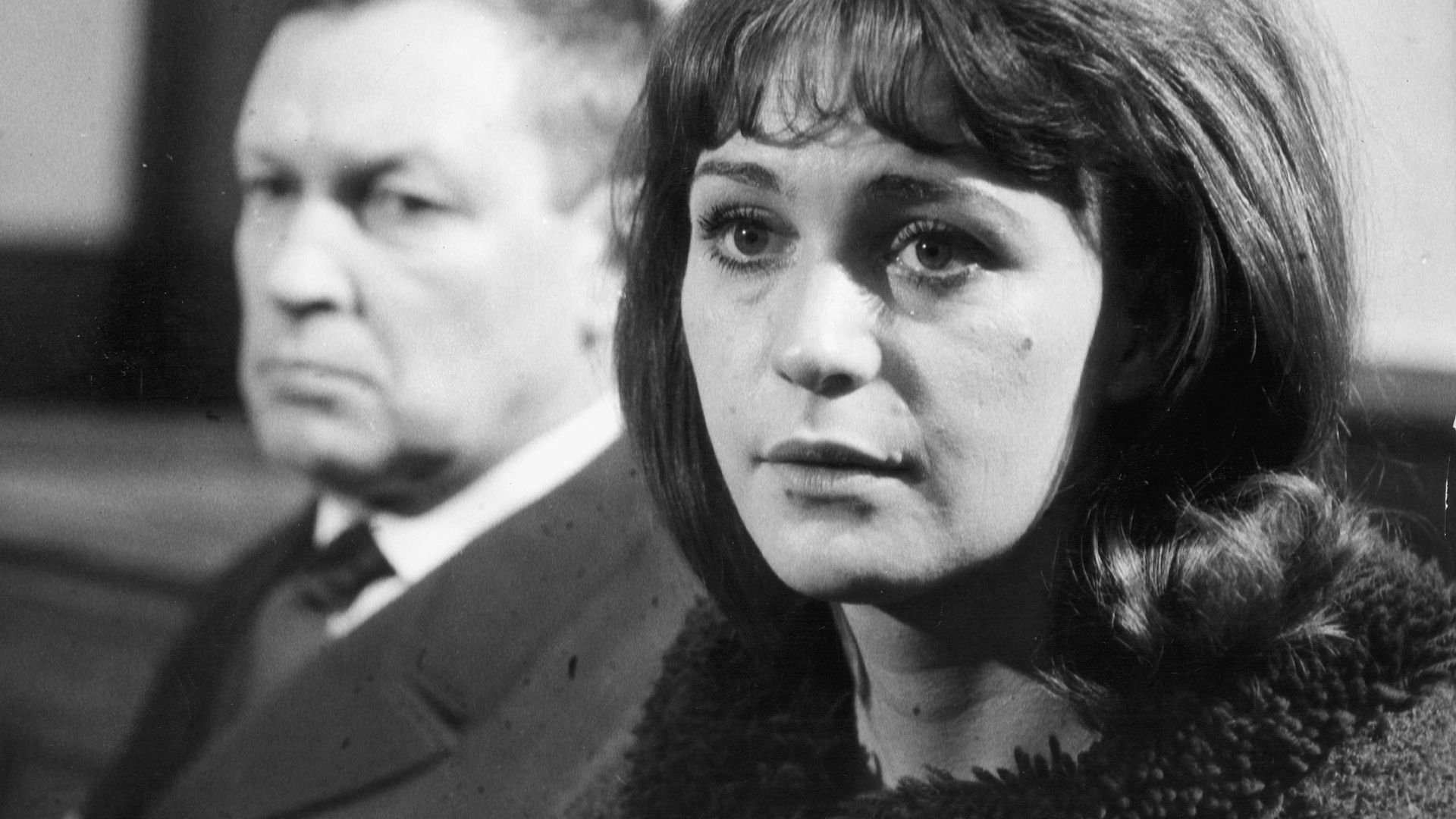
Yesterday Girl is rich and intelligent; and even despite the apparent and immediate brashness of the style, there is also something remarkably subtle about it. The film is largely defined by its understated though continued instances of historical and cultural effacement. The opening courtroom scene immediately establishes this in just how easily the judge dismisses the murder of Anita’s grandparents, the dispossession of her parents’ property, and Anita’s own expulsion from school during the Holocaust (the irony here, of course, is that this is likely a War-time judge whose service to ‘justice’ was directly complicit in the Nazi regime). We also see this in the parole officer, whose superficial attempts to reform Anita through a kind of insipid Christian devotion furthers this representation of a culture which in the face of its own shame, reflexively retreats into conservatism.
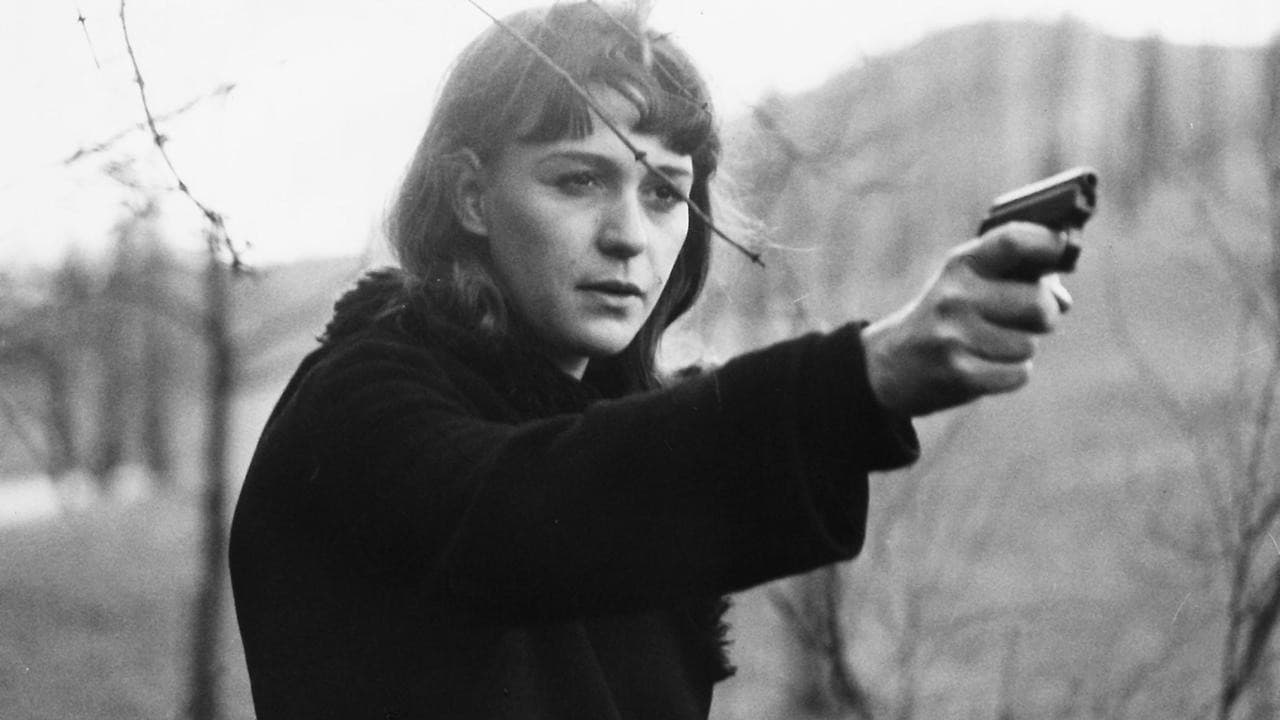
It is not so much the case that Anita is on the societal margin as it is that the margin itself has been erased. She is entirely out of joint with the Germany around her which, despite its vast technological leaps and its thrusting itself into a modern capitalist model of mass consumerism and global interconnectivity, remains lingering insidious and hostile.
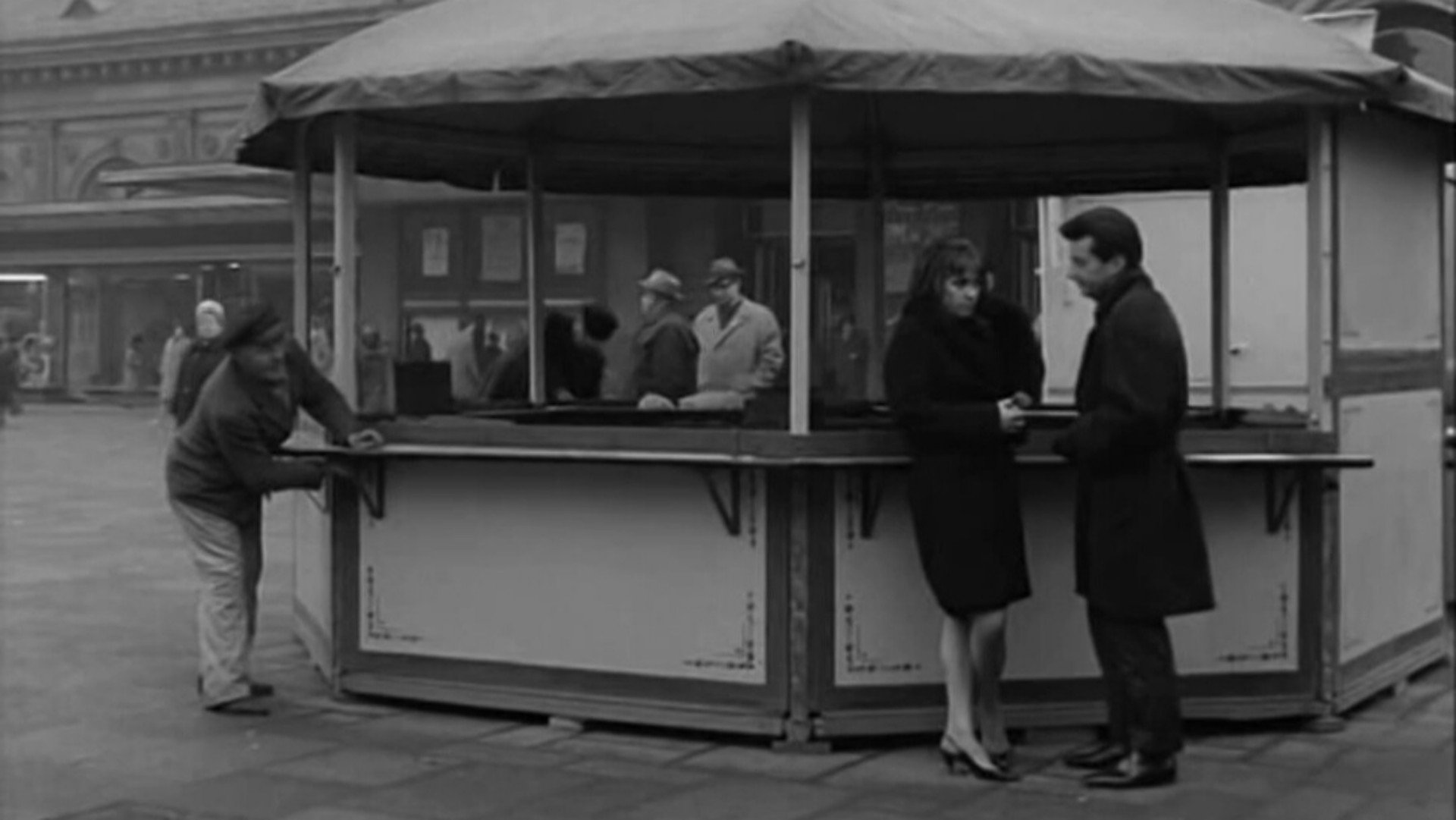
Yesterday Girl is generously peppered with these extra-narrational tableaux of a city in motion, usually entailing some kind of experimental bent such as the use of time lapses or montages or documentary filmmaking or discontinuity. The effect of this, when the general tableau of West German commerce is contrasted with the more intimate portrait of Anita, is stark. If our general story of modern Germany is one of relentlessly turning gears and ceaseless swathes of cars, a society moving inexorably forward, then Anita’s story is one of repetition and stagnation. The repetitiveness of this film is not a coincidence. Anita is cyclically stealing, evading the law, getting jobs, losing jobs, being kicked out of hotels, lying, and engaging in trivial love affairs. In a society which would rather ‘move on’ from its crimes than comprehensively address them, there is little else to do but this. This societal obtuseness is continually played for comic effect, such as, for instance, the scene where Anita’s supposedly sagacious professor, when asked for advice about a real-world material problem, can only babble in vague abstraction about ethics. Another instance is whenever the character of Pichota frustratedly tries to teach Anita passages from Kafka - not only forcing her to recite from a Jewish figure, but also from a passage which almost perfectly encapsulates Anita’s dilemma. She as a character is expected to assimilate into post-War West Germany, and to bury her proverbial head in the sand along with the rest of its population. But for obvious reasons, both material and abstract, she is fundamentally incapable of doing so; indeed, perhaps on some level, even innately morally repelled at the idea of doing so.
The question then inevitably turns to how Anita establishes her agency and asserts her own sense of identity amidst this climate. Kluge’s overall structure and on a more particular level, his structuring of individual scenes, certainly points towards Anita’s sense of Self as being atomised and totally discombobulated. The overall, cyclical structure of the film on top of Kluge’s unorthodox casting-aside of any notion of plot or narrative causality makes for a film which on an overall level seems utterly disjointed. Compoundingly, the individual techniques utilised by Kluge on a scene-to-scene basis are also incredibly jarring and disjointing. The casual jump cuts, the unmotivated flash-forwards, the lapses into interview, the insertion of generalised sequences of the city, the changing of narrative perspective to new characters (for example the solitary scene of Mrs. Pichota talking about her knowledge of her husbands affair with Anita), and the use of jarring narrative ellipsis, especially through the use of intertitles, all function for this purpose.
However, it would be inaccurate and cynical to suggest that
Yesterday Girl’s structure acts solely as a vehicle for the presentation of a lack of identity. First and foremost, Kluge’s camera is totally emancipated, moving in handheld, liberated fashion. There is absolutely an element of kineticism and vivacity to Anita’s portrayal which in many ways liberates her as an autonomous character in the film, her actions typified by a sense of free will. On a primitive surface level, she is undoubtedly a liberated character who acts in accordance with her own whims. The use of discontinuity editing and jump cuts as well, whilst as previously established, being endowed with an alienating and socially constricting quality, still nevertheless concurrently contribute to this blasé sense of personal liberation. I think it would be too simplistic to suggest that Kluge’s approach to editing, which is only really matched by Godard as to how radical it was at the time, serves only one purpose; its effect is at varying points both freeing and oppressive, intimate and alienating, authentic and foreign. In this sense, Anita’s sense of identity, and the degree to which it is lacking, is at once defined by and at once defined in opposition to the environment and society around her.
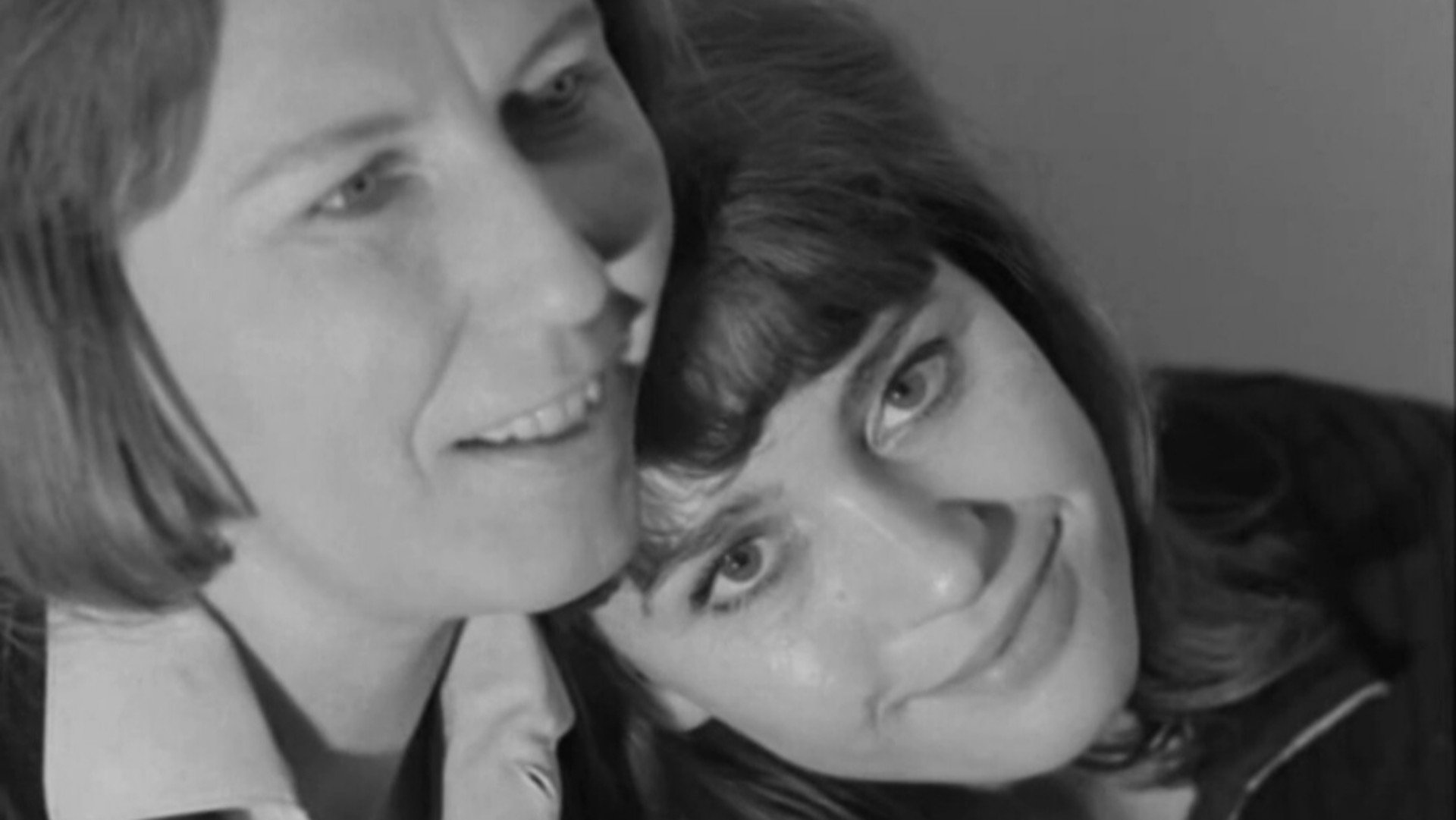
Anita’s sense of personal liberation runs against the grain of the oppressive mise en scène, and whilst it could hardly be said to triumph over her social position, it could still certainly be said to have some effect. In the structural chaos of this film, there exist these irregular sparks of genuine, unaffected self-realisation, these moments of actualisation in a society defined by affectation. The most notable example is probably Anita’s highly experimental supposed dream sequence, which seems to act as a kind of breaking-off from the constraints hitherto binding her down. But I think most effectively, one could cite the scene of Anita’s one night stand with an unnamed lover. The scene begins with these almost uncomfortably intimate wide angle lensed close-ups of their faces looking at each other before cutting to a bedroom where their romance seems almost to be defined by its playfulness and sense of strange curiosity - they do quite literally play in this scene, doing handstands and play-fighting. As regards to this, Anita’s character as a symbol of corrupted innocence is certainly relevant; I think this scene could quite easily be cross-referenced with an earlier, utterly beautiful diversion in the film where during Anita’s first stay in prison we cut to a sequence where a children’s short poem about a mammoth thawed out of ice is recited (the aforementioned idea of being out of joint with the present certainly comes into play here too). Interestingly, however, during the love scene, notably titled ‘A Day of Repentance’, Anita makes mention of the lineage of Prussia from Wilhelm I to Frederick the Great and of the Kapp Putsch, though in a sort of slovenly, removed manner, which highlights a sense of remoteness between her notion of history and her immediate, everyday problems. However, when the subject of the Holocaust is brought up, the conversation becomes noticeably vital and incisive, even poetic. Kluge then jump-cuts to the irony-laced action the two lovers humming to the German national anthem over a crudely cut montage of Holocaust victims’ graves. This scene above all, highlights
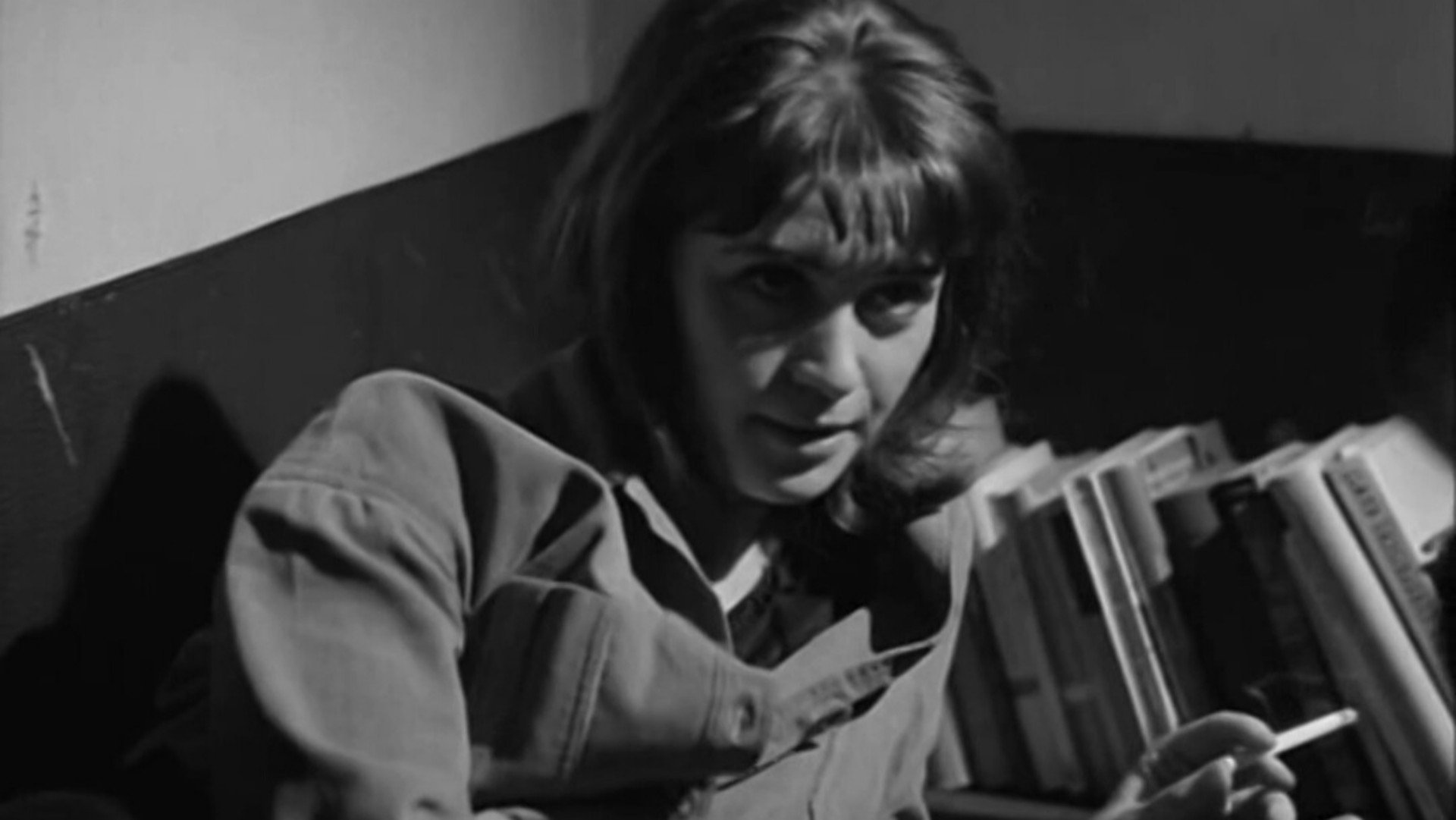
Yesterday Girl’s overarching conceit: the tremendous hypocrisy of post-War Germany, where a benign and dormant notion of German traditional history is disingenuously insisted upon, but where its immediate, more animate history is ignored as something to be moved on from; as something which occurred in a vacuum. Again, the very fact of Anita’s existence, not only as a Jew but also as an East German immigrant and a woman, is a contradiction which is fundamentally incompatible with this society. It’s one of the only scenes in the film where Anita herself seems to express a self-awareness about the dynamics of her situation and social position (for a protagonist she talks surprisingly little, or at least with surprisingly little substance). These sparks of genuine, inter-personal sentiment occur only as glittering fragments in an otherwise dull and oppressive environment, but they at the very least signify a capacity for cotemporary Germany to comprehensively address its own past.
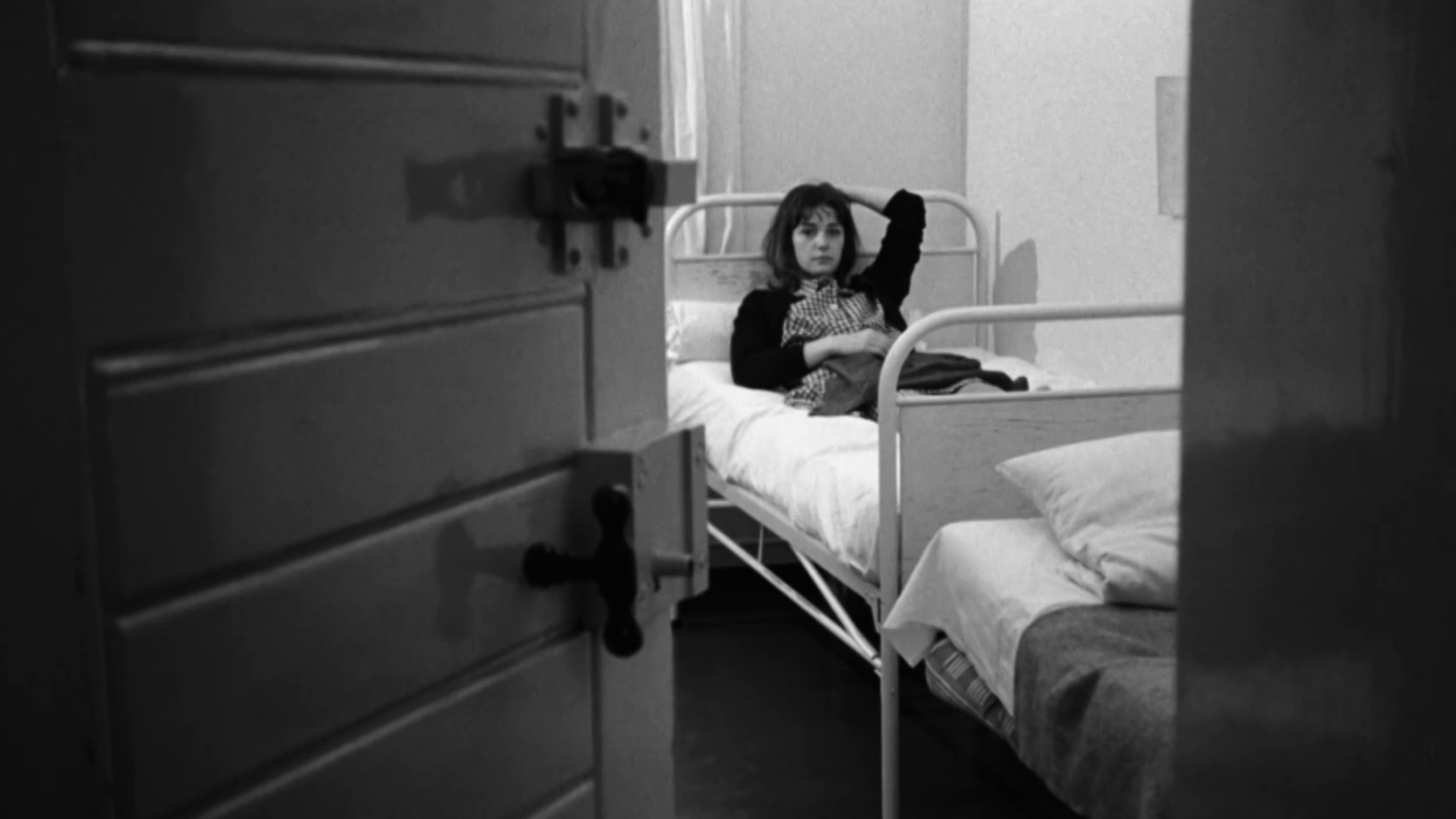
That being said, I think it would be going too far to suggest that Anita’s character is a symbol of triumph. The overall trajectory of the film from start to finish remains cyclical, Anita’s opening lines, ‘Did he separate the daughter from the mother? Did he no set free a prisoner, unite a prisoner? Did he not show the incarcerated the light? Did he say of a prisoner, “Catch him”’, reflecting the film’s ending, where she turns herself in and essentially imprisons herself. Much like in Bresson’s
Pickpocket, Anita’s only resolution is to imprison herself. However, unlike
Pickpocket’s Michel, where this paradox of freedom in incarceration is the result of a transcendental passion whose end is the attainment of grace, Anita’s self-imprisonment is tied to something much more material, and much less elevated. It is merely Anita’s unsustainable material conditions and alienation from society which motivates this decision. There is no higher end in mind; it is merely an act of submission. Whilst Anita is not totally defeated as a character, maintaining a sense of personal dignity and freedom, the film ultimately suggests that this is insufficient to surmount one’s social burdens. For Kluge, the individual and the societal organism they inhabit are not mutually exclusive or separable but are intrinsically and inextricably imbued. In order for Kluge’s indictment of the very mechanisms of German society to work effectively, Anita’s character cannot be allowed to, through sheer force of her personal will as a character, overcome her social immobility and alienation.
On a separate level, I would also like to make brief mention of realism in the film, because whilst on one hand, significant elements of Kluge’s style run very much contrary to conventional understandings of filmic realism (Kluge spurns realist cornerstones such as linear continuity, an intensified approach to duration and temporality, a camera whose viewpoint and agency is limited, and an unwavering adherence to the fictional diegesis), I would nevertheless argue that he subverts these techniques for the purpose of achieving another kind of realism; a phenomenological realism which is more concerned with an accurate depiction of real experience than of real life. Essentially, this denotes a shift from an objective to a subjective realism. Kluge’s jump cuts, for example, are certainly still stylish and formalist, but they also represent a subjective reality, the same kind that Bergson argues we experience in
Creative Evolution:
‘We take snapshots, as it were, of the passing reality, and, as these are characteristic of the reality, we have only to string them on a becoming, abstract, uniform and invisible, situated at the back of the apparatus of knowledge, in order to imitate what there is that is characteristic in this becoming itself.’
The realism expressed by Kluge’s elliptical and non-linear editing style is a psychological realism. It is temporal reality depicted not for what it actually
is (that is, something which is concrete, transient, continuous, and rejecting of binary uniformity) but in terms of how it is subconsciously experienced (in an abstract, non-continuous, fragmented fashion). Kluge’s ever-mobile handheld camera only augments this sense of fragmentation and psychological depiction of subjective reality. The other most notable use of this elliptical editing style in cinema is in Godard’s
Breathless, which uses it for a somewhat similar effect, but ultimately chooses to insist on its capacity as a tool for style, not realism. Kluge’s fragmented and often difficult representation of Anita’s life is quite consciously intended to elicit something viscerally authentic to the human experience. Outside of this phenomenological argument for realism in
Yesterday Girl, I think the claim is reinforced by certain other choices in style Kluge also makes. The film’s occasional diversions into fictional interviews, the common use of on-location documentary filmmaking for street scenes, and the natural, unaffected, grey-toned lighting, suggest an inclination on the part of Kluge towards realism.
I feel uncomfortable rating this film higher than its current rating for the same reason I feel uncomfortable rating many of Godard’s works higher than what I tend to rate them. Indeed, the similarities between
Yesterday Girl and Godard, but especially
Masculin Féminin and
Vivre Sa Vie are unmistakable, and the latter’s influence upon the former’s approach cannot be overstated. Whilst it would be wrong to deny this film’s brilliance and its revolution of film form and our understanding of what it is capable of, there are elements of it which just meander too much in abstraction, and whose elusiveness is not accounted for by some kind of sensory or impressional effect. It is films like this, and I’m sure Kluge himself would be happy to hear this, which make me question my conviction in the very idea of a binary or objective rating system. These kinds of films expose it for what it is - arbitrary.
Yesterday Girl is ultimately too dynamic and vital to be fully appropriate for such things.