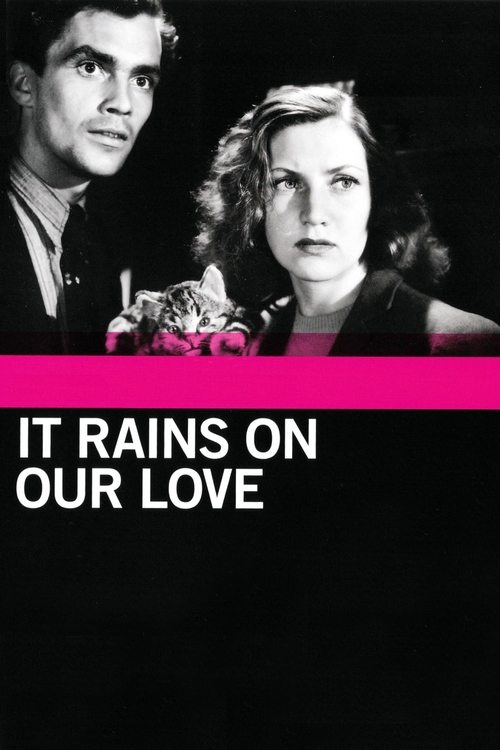
"Lorens [Marmstedt] was a harsh teacher. He was ruthlessly critical and forced me to reshoot scenes he found poor. He could say: 'I've been speaking with Hasse Ekman, who has seen the rushes, and I've had spoke to Kilbom. I must keep things open! It may well be that you won't be allowed to finish shooting. Bear in mind that Birger Malmsten is no Jean Gabin, and most of all, you are no Marcel Carné.' Lamely I try to defend myself by pointing out some scenes I thought were pretty good. Then Lorens looked at me with his icy light-blue eyes and said: 'I don't understand how you can wallow in this simmering self-satisfaction!'
I raged; I was desperate and humiliated, but I had to admit he was right. Every day, he took the trouble to sit through the rushes. Even though he criticized and insulted me in front of the staff, I had to take it since he was participating passionately in the birth and development of the film. I cannot remember that he praised me even once during It Rains on Our Love for anything I had done. What he did do was give me a lesson. He said: 'When you and your pals see the dailies, you're in a state of emotional chaos. No matter what, you want everything to be good. That's the reason you have a natural tendency to make excuses for your failures and overestimate what you are seeing. All of you are supporting one another. This is normal, but it's also dangerous. Submit yourself to a psychological exercise. Don't be enthusiastic. Don't be critical, either. Put yourself at point zero. Don't let your emotions get involved in what you're seeing. Then you'll see everything.' This piece of advice has been invaluable to me throughout my professional life."
The film’s cultural significance lies in its gentle critique of societal norms, reflecting an era when old moral codes were being questioned. While not as incendiary as some contemporaries, the narrative highlights class prejudice and the difficulty of escaping one’s past. By doing so, it speaks to a culture wary of outsiders but also yearning for compassion, subtly acknowledging the uneasy moral terrain of a rebuilding Europe. Though not a landmark cultural artifact, it still quietly mirrors a collective desire for empathy.
Historically, it also captures a post-war Scandinavian cinematic landscape starting to find its voice. While the film did not spark immediate international acclaim or widespread critical reverence, it contributed to establishing Bergman’s credentials. It’s a stepping stone, showcasing tentative explorations of themes that Bergman would refine in later masterpieces: existential dread, societal judgment, and the fragility of human connection.
Beneath its straightforward narrative of two outcasts striving to create a home amid societal skepticism lies a deeper commentary on the resilience of love. The protagonists’ shared journey underlines how compassion can sprout in hostile environments, suggesting that human dignity persists despite oppressive circumstances. Their struggle to be acknowledged as decent human beings resonates with any period of rebuilding, when societies must confront their prejudices and decide whether to extend a helping hand. This theme—love as a shelter from judgment and despair—offers a universal truth that transcends the film’s modest scale, foreshadowing Bergman’s future examinations of moral quandaries and human vulnerability. In this gentle drama of outsiders under gray skies, one finds both the tender roots of a great auteur’s future achievements and a quietly relevant reminder that compassion, however understated, remains a worthwhile pursuit.
"Lorens [Marmstedt] was a harsh teacher. He was ruthlessly critical and forced me to reshoot scenes he found poor. He could say: 'I've been speaking with Hasse Ekman, who has seen the rushes, and I've had spoke to Kilbom. I must keep things open! It may well be that you won't be allowed to finish shooting. Bear in mind that Birger Malmsten is no Jean Gabin, and most of all, you are no Marcel Carné.' Lamely I try to defend myself by pointing out some scenes I thought were pretty good. Then Lorens looked at me with his icy light-blue eyes and said: 'I don't understand how you can wallow in this simmering self-satisfaction!'
I raged; I was desperate and humiliated, but I had to admit he was right. Every day, he took the trouble to sit through the rushes. Even though he criticized and insulted me in front of the staff, I had to take it since he was participating passionately in the birth and development of the film. I cannot remember that he praised me even once during It Rains on Our Love for anything I had done. What he did do was give me a lesson. He said: 'When you and your pals see the dailies, you're in a state of emotional chaos. No matter what, you want everything to be good. That's the reason you have a natural tendency to make excuses for your failures and overestimate what you are seeing. All of you are supporting one another. This is normal, but it's also dangerous. Submit yourself to a psychological exercise. Don't be enthusiastic. Don't be critical, either. Put yourself at point zero. Don't let your emotions get involved in what you're seeing. Then you'll see everything.' This piece of advice has been invaluable to me throughout my professional life."
The film’s cultural significance lies in its gentle critique of societal norms, reflecting an era when old moral codes were being questioned. While not as incendiary as some contemporaries, the narrative highlights class prejudice and the difficulty of escaping one’s past. By doing so, it speaks to a culture wary of outsiders but also yearning for compassion, subtly acknowledging the uneasy moral terrain of a rebuilding Europe. Though not a landmark cultural artifact, it still quietly mirrors a collective desire for empathy.
Historically, it also captures a post-war Scandinavian cinematic landscape starting to find its voice. While the film did not spark immediate international acclaim or widespread critical reverence, it contributed to establishing Bergman’s credentials. It’s a stepping stone, showcasing tentative explorations of themes that Bergman would refine in later masterpieces: existential dread, societal judgment, and the fragility of human connection.
Beneath its straightforward narrative of two outcasts striving to create a home amid societal skepticism lies a deeper commentary on the resilience of love. The protagonists’ shared journey underlines how compassion can sprout in hostile environments, suggesting that human dignity persists despite oppressive circumstances. Their struggle to be acknowledged as decent human beings resonates with any period of rebuilding, when societies must confront their prejudices and decide whether to extend a helping hand. This theme—love as a shelter from judgment and despair—offers a universal truth that transcends the film’s modest scale, foreshadowing Bergman’s future examinations of moral quandaries and human vulnerability. In this gentle drama of outsiders under gray skies, one finds both the tender roots of a great auteur’s future achievements and a quietly relevant reminder that compassion, however understated, remains a worthwhile pursuit.